Fashion AI from the platforms: what Google, OpenAI, Amazon, Shopify and the model labs are building
Try-on in Search, shopping in ChatGPT and Gemini, Amazon's assistant, agent payment protocols and feed specs: what the platforms launched from 2024 to 2026, what their numbers show, and what brands should do.
The tech platforms and model labs spent 2025 and 2026 building the rails for AI shopping: try-on in Google Search and the Doppl app, shopping in ChatGPT, Gemini and Copilot, Amazon's assistant (now Alexa for Shopping), and open protocols for agents to browse and pay. The evidence so far says discovery moved faster than checkout. Traffic to retail sites from AI tools grew by more than a thousand per cent, while OpenAI scaled back its in-chat Instant Checkout in March 2026 after Walmart saw in-chat purchases convert three times lower than click-outs. Every protocol now promises that the merchant stays the merchant of record, and the entry ticket to all of it is clean, variant-level product data.
This is part six of our fashion AI research series and the last of five deep dives. It covers Google, OpenAI, Anthropic, Amazon, Adobe, Shopify, Salesforce, Nvidia, Microsoft, Meta and the payment networks, separating launches from measured results and noting where a vendor's numbers serve the vendor.
What have the platforms launched for fashion shoppers?
Google: try-on at search scale
Google launched virtual try-on in Shopping in June 2023, showing how a garment drapes on real models from XXS to 4XL across skin tones, with a commissioned survey finding 42% of online shoppers did not feel represented by model images. At I/O in May 2025 it added try-on with your own photo across "billions of apparel listings", AI Mode shopping on a Shopping Graph of more than 50 billion listings, and agentic checkout that buys after the shopper confirms. In June 2025 Google Labs released Doppl, an app that puts any outfit image on a digital version of you, with its own caveat: "Fit, appearance and clothing details may not always be accurate." By November 2025 agentic checkout was live for eligible US merchants, and "Let Google Call" phoned local stores about stock.
OpenAI: from checkout back to discovery
ChatGPT added shopping results in April 2025. In September 2025 Stripe and OpenAI launched Instant Checkout and the open Agentic Commerce Protocol, starting with Etsy sellers and naming Shopify brands such as Glossier, Vuori, Spanx and SKIMS to follow. Walmart announced it would sell through ChatGPT in October 2025, and said in the same release that AI had cut its fashion production timelines by up to 18 weeks.
Then the evidence arrived. Modern Retail reported in March 2026 that OpenAI said its first version "did not offer the level of flexibility" it wanted, that merchants could now use their own checkout, and that Walmart's in-chat purchases converted three times lower than click-outs. Missing pieces included live inventory, promotions, loyalty and store pickup. Retail Gazette described ChatGPT shopping as repositioned towards discovery and comparison, with image uploads and attention to budget and style.
OpenAI's most useful output for brands may be its product feed specification: one row per variant, nine required fields, each size and colour as its own row with a size system ("no size conversion is implied"), colour-matched images, material, and reviews that exclude store reviews.
Amazon: the walled garden
Amazon's fashion AI has focused on fit rather than imagery: personalised size recommendations and fit insights summarised from same-size buyers' reviews, at billions of recommendations a month, with fewer fit-related returns described as an aim rather than a reported result. Its assistant Rufus reached 250 million customers in 2025; Andy Jassy said it was expected to generate over $10 billion in annual incremental sales, using a seven-day downstream attribution model. Renamed Alexa for Shopping in May 2026, it had more than 400 million users in the twelve months to October 2026. Amazon also sued Perplexity over its shopping agent in November 2025 and blocks other companies' agents, while piloting "Buy for Me", which buys from brands' own sites inside the Amazon app.
Shopify: open to every agent
Shopify took the opposite path. In January 2026 it launched the Universal Commerce Protocol with Google, letting merchants sell inside AI Mode and Gemini (Gymshark and Everlane among the first), Copilot Checkout with Microsoft, and ChatGPT, all managed from the Shopify admin. Its Fall '26 developer release opened catalog, cart and checkout to "any agent or app". Its president said "discovery is the bulk" of what people want from agentic shopping, and AI-channel orders land in the merchant's admin with the customer's details.
Meta, Microsoft and the payment networks
Meta launched Muse, a personal agent that checks with the person before any purchase, in September 2026. Microsoft added shopping to Copilot in April 2025. Google's Agent Payments Protocol (AP2) launched with more than 60 organisations, using signed "mandates" to record what a shopper authorised. Visa Intelligent Commerce and PayPal's deal with Perplexity added agent credentials, and Stripe's Agentic Commerce Suite (December 2025) named Coach, Kate Spade, URBN and Revolve among its brands.
Anthropic: protocols and guardrails
Anthropic's Model Context Protocol (November 2024), an open standard for connecting AI assistants to the systems where data lives, became a named layer inside AP2, UCP and Visa's tooling. Its guidance on building agents advises starting with "the simplest solution possible", because agents add cost and compounding errors. In September 2026 it published a commerce agents blueprint in which changes by the merchant agent need human sign-off and payment is left to the merchant; its reference code stages merchant changes until a person approves and never places orders. Anthropic reported partners seeing carts up to 35% larger; the partners are unnamed.
What do the platforms' own numbers say?
| Source | Claim | How to read it |
|---|---|---|
| Adobe, March 2025 | AI referrals to US retail sites up 1,300% over holiday 2024; AI visitors convert 9% less than others; apparel converts lowest, jewellery among the highest | Large first-party panel; the channel is still small |
| Salesforce, January 2026 | AI and agents drove $262bn of holiday 2025 online sales; AI-referred shoppers converted 9x better than social | "Drove" and "influenced" are broad; social is a low baseline |
| Salesforce, July 2026 | Agentic search as a journey's first step up 200%; discovery via brand-owned properties down 7% | Method disclosed; one of the better vendor datasets |
| Amazon, 2025 to 2026 | Rufus users 60% more likely to buy; Alexa for Shopping users spend 50% more | Users self-select; correlation, not effect |
| Shopify, October 2026 | 65% of shoppers plan to use AI for a shopping task; about a third trust an agent to buy | Vendor survey; case studies hand-picked |
| Nvidia, January 2026 | 91% of retailers using or assessing AI; 47% using or assessing agents, of whom 20% have them live | Roughly 9% of respondents with agents in production |
| Google Cloud, September 2025 | 74% of executives report ROI within a year | Sample only of firms already using gen AI; self-reported |
The tension between Adobe and Salesforce is the most instructive. Adobe found AI traffic converting below average and lowest in apparel; Salesforce found it converting far better than social traffic. Both can be true, because the baselines differ, and both companies sell AI tooling. For a brand, the right number is your own, measured against your own channels.
What is the platforms' published guidance for brands?
- Structured, variant-level product data. OpenAI's feed spec, Google's Shopping Graph and Shopify Catalog all reward one row per size and colour, accurate images and plain attributes.
- Be legible to agents. Shopify advises plain-language descriptions of the problem a product solves and its value, because agents otherwise compare on price.
- Keep people in the loop for anything the merchant changes. Anthropic's blueprint stages merchant writes for approval; Shopify's Campaign Autopilot requires merchant approval; Meta's Muse checks before a purchase.
- Use commercially safe imagery with provenance. Adobe says Firefly is trained on licensed and public-domain content with IP indemnity for enterprise customers; Google joined the C2PA steering committee and surfaces Content Credentials in Search.
- Start simple. Anthropic's agent guidance favours predictable workflows over open-ended agents where they will do.
Where do the platforms disagree, and what is unresolved?
- Open or walled. Shopify opens to any agent; Amazon sues and blocks them, and plans to be the primary agent on its own store. Salesforce reported that Amazon blocked Meta's Muse within two weeks while Shopify shipped a connector.
- Who carries the risk. AP2 creates an audit trail but does not allocate liability; Anthropic's blueprint leaves payment to the merchant. Who pays when an agent buys the wrong size is still open.
- Merchant control. Every protocol says the merchant stays merchant of record, yet retailers stepped back from Instant Checkout partly because loyalty, promotions and cross-sell were missing.
- Try-on accuracy. Google's own Doppl warns that fit may be inaccurate. No platform has published a returns reduction from image try-on; the fit work with numbers behind it, at Amazon and Zalando, is size advice.
- Service load. Salesforce argues personal agents will drive more contact-centre traffic than they save, calling round the clock about orders and returns.
What does this mean for stores?
Almost all of this platform activity is online. M13, citing industry data, notes that physical retail is still about 80% of global commerce, and the platforms' own moves show they know it. Google's "Let Google Call" phones local stores about stock and price; Amazon's Lens Live matches products a shopper points a camera at in the real world; Meta's Muse is "coming soon to AI glasses". Each of these brings an agent to the edge of the store and stops there.
Two consequences follow for brands with shops. First, store stock and prices need to be as machine-readable as the online catalogue, because agents will increasingly ask about them before a visit. Second, the store is the one place where the brand, not the platform, sees the whole interaction: what was tried, what was asked for, what was bought and what came back. Salesforce found discovery through brand-owned properties falling as journeys start in AI chats. The shop floor is a brand-owned property that platforms do not mediate, and the data it produces is first-party by default.
What should a fashion or jewellery brand do with this?
- Fix your product data before anything else. Every platform's door opens on it. Part eight lists the fields.
- Own a brand stylist on your own channels. The platforms' own products for retailers, from Google's Gemini Enterprise for CX to Salesforce's shopper agent and Anthropic's blueprint, all point to "your agent on your site", with click-out to your checkout.
- Treat try-on as inspiration and size advice as the fit tool. Measure returns yourself.
- Jewellery should take AI visibility seriously. Adobe found jewellery among the highest-converting categories from AI referrals.
- Use indemnified image tools and label AI imagery. Provenance is becoming a platform expectation.
- Plan for agents as customers of your service team, not only of your shop.
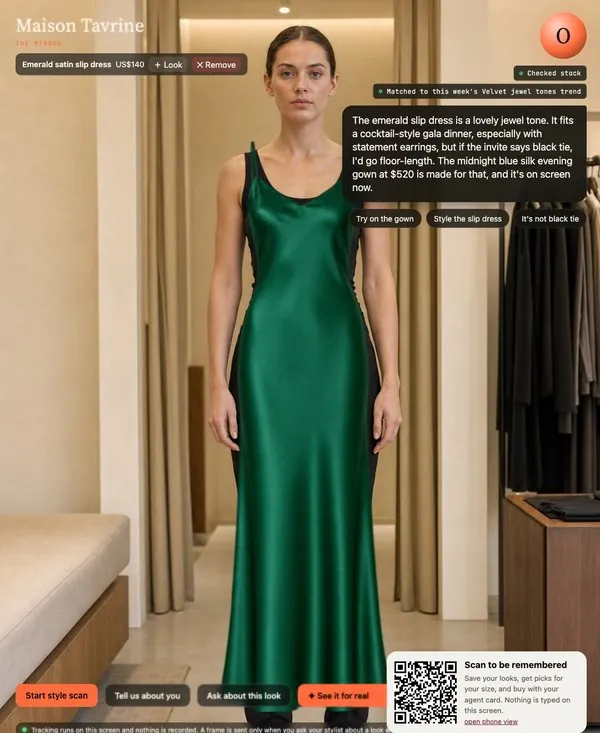
The physical store sits outside most of this platform activity, and that is an opening. Ateliq's in-store stylist answers from the store's own catalogue, sizes, prices and offers, never takes payment on the screen, and hands the sale to a hold, a pay link, the brand's online cart or the counter. Its agents run on Nagent's agent platform, save drafts only, and wait for a person to approve anything a shopper or the public will see. Those are the same guardrails the platforms recommend, applied on the shop floor.
Next in the series, we move from what the world is saying to what to do: a 90-day agentic AI pilot for a fashion or jewellery brand.
Sources
- Google: Virtually try on clothes with a new AI shopping feature (14 June 2023)
- Google: Shop with AI Mode (20 May 2025)
- Google Labs: Doppl (26 June 2025)
- Google: Agentic checkout for the holidays (13 November 2025)
- Google Cloud: Agent Payments Protocol (September 2025)
- Google Cloud: ROI of AI study (4 September 2025)
- Google: Transparency for gen AI content with the C2PA (17 September 2024)
- Stripe: Instant Checkout in ChatGPT and the Agentic Commerce Protocol (29 September 2025) and Agentic Commerce Suite (11 December 2025)
- OpenAI: Product feed specification
- Walmart: Partnership with OpenAI (14 October 2025)
- Modern Retail: What went wrong with ChatGPT's Instant Checkout (27 March 2026)
- Retail Gazette: OpenAI pivots ChatGPT shopping strategy (25 March 2026)
- Anthropic: Introducing the Model Context Protocol (25 November 2024)
- Anthropic: Building effective agents (19 December 2024)
- Anthropic: Building commerce agents with Claude (2 September 2026) and reference repository
- Amazon: How Amazon Fashion uses AI for fit (8 January 2024)
- Digital Commerce 360: Amazon pilots Buy for Me (8 April 2025)
- Amazon: Q3 2025 results (30 October 2025)
- Fortune: Rufus and $10 billion in sales (2 November 2025)
- CX Dive: Amazon sues Perplexity (7 November 2025)
- Modern Retail: Alexa for Shopping, 400M customers (29 October 2026)
- Adobe Analytics: Traffic from generative AI sources (17 March 2025)
- Adobe: Approach to generative AI with Firefly
- Shopify: The agentic commerce platform (11 January 2026), the first holiday season of the agentic era (6 October 2026), Fall '26 Edition for developers and Fall '26 Edition feature (28 October 2026)
- Salesforce: Holiday 2025 data (8 January 2026), Agentic search grows 200% (28 July 2026) and Personal agents and contact centres (19 October 2026)
- Nvidia: State of AI in Retail and CPG 2026 (7 January 2026)
- M13: The new rails of agentic commerce (25 February 2026)
- Microsoft: Your AI Companion (4 April 2025)
- Meta: Introducing Muse (8 September 2026)
- Visa Intelligent Commerce and PayPal and Perplexity (14 May 2025)
Questions people ask
Can shoppers buy fashion inside ChatGPT?
OpenAI launched Instant Checkout with Stripe in September 2025, but in March 2026 it said the first version lacked flexibility and moved to letting merchants use their own checkout. Walmart reported that in-chat purchases converted three times lower than click-outs.
Is Google's virtual try-on accurate for fit?
Google does not claim so. Its Doppl app says fit, appearance and clothing details may not always be accurate. Try-on with your own photo is a styling aid; no platform has published a returns reduction from image try-on.
What product data do AI shopping agents need?
OpenAI's feed specification asks for one row per variant with nine required fields, each size and colour as its own row with a stated size system, colour-matched images, material and product-only reviews. Google's Shopping Graph and Shopify Catalog reward the same detail.
Does AI-referred traffic convert better?
It depends on the comparison. Adobe found AI-referred traffic converted 9% below other traffic in early 2025, lowest in apparel and among the highest in jewellery; Salesforce found AI-referred shoppers converted far better than social-referred ones. Measure your own channels.
What is the Universal Commerce Protocol?
An open standard co-developed by Google and Shopify, launched in January 2026, that lets merchants sell inside Google AI Mode and Gemini while remaining the merchant of record. It works alongside Google's Agent Payments Protocol and Anthropic's Model Context Protocol.