Virtual try-on for fine jewellery: why the photo matters more than the overlay
Flat overlays make fine jewellery look pasted on. How a two-layer approach, a live preview plus a photo made from the exact catalogue piece, gets earrings and chains to look worn.
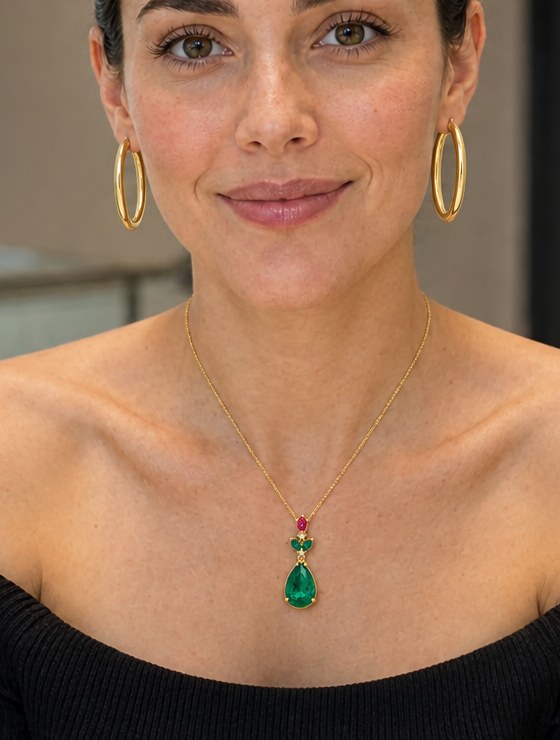
Fine jewellery is the hardest thing to try on virtually. A dress covers most of the body and forgives small errors in position. An earring is a few centimetres long, hangs from one precise point, catches light from every angle and sits next to the most closely watched part of the frame: the face. When it is wrong by a few millimetres, everyone can tell.
Most virtual try-on for jewellery works the same way. The software finds the face, places a flat picture of the earring near the ear, and scales it to the face. The result moves with the shopper, which is impressive for a second, and then it looks like a sticker. The hoop floats beside the cheek instead of hanging through the lobe. The chain of a pendant sits on the chest as a flat V, because that is how it was photographed on the table. The light on the metal is the studio's light, not the store's.
Why a flat overlay can't look worn
Three things make a piece look worn, and a flat overlay has none of them.
- Attachment. An earring goes through the lobe. The hook disappears behind the ear, and the visible part hangs from the piercing. A necklace goes behind the neck; the chain lies on the skin and follows the collarbones.
- Scale. A 3 cm hoop is 3 cm on everyone. Scaling a piece to the face gets the proportion roughly right but not the size, and size is what a shopper is deciding on.
- Light. Gold reflects the room it is in. A piece photographed under studio light, laid onto a camera feed in a softer store, looks like it is glowing from inside.
You can improve an overlay a great deal: hide the hook behind the lobe, reshape a chain so it drapes, match the brightness to the room. We do all of that on the live screen. But a live screen redraws thirty times a second, and there is a limit to what it can do in that time.
Two layers: a live preview and a real photo
Ateliq separates the two jobs. The live screen is for browsing: the shopper sees clothes follow them as they turn and can try piece after piece without waiting. When they want to see jewellery properly, the stylist makes a photo.
That photo is made by an image model, and the important part is what the model is given. It does not get a name like "emerald pendant" and invent one. It gets the shopper's photo and the exact cut-out of each piece from the brand's own catalogue photo, with instructions written for that kind of piece: a hoop hangs through the lobe with the hook hidden; a pendant's chain goes behind the neck and drapes over the collarbones; a stud sits flat on the lobe. Where the catalogue has a size in millimetres, the model is told the real size. The shopper's own clothes, face, hair and background are kept exactly as they are.
The result takes about half a minute and looks like a photograph, because it is lit like one: real reflections on the metal, a soft shadow where the chain touches the skin, hair falling over an earring where it naturally would.
Keeping the piece true to the catalogue
An image model can drift. It might simplify a setting or round off an oval hoop. Three things keep the piece honest.
- The source is the brand's own photo. Ateliq removes the background from each product photo and keeps every pixel of the piece. That cut-out is what the model copies from.
- The instructions name what must not change: shape, proportions, metal colour, the cut and number of stones, the setting and the chain.
- The photo is labelled as made by AI from the shopper's photo, so nobody mistakes it for a product shot.
What brands should prepare
Try-on quality starts with the catalogue. The two things that help most are simple.
- Packshots on a plain background. One piece, evenly lit, nothing else in frame. A photo of a pair of earrings is split into left and right automatically.
- Sizes in millimetres. An earring's length from hook to tip, and a necklace's width from chain end to chain end. With these, pieces appear at their real size.
Privacy
The live screen tracks the shopper in the browser and records nothing. A photo is taken only when the shopper asks for one, after they agree on screen, and it is deleted after 30 minutes unless they save it to their phone. Ateliq never infers race, ethnicity or weight.
Jewellery is bought on how it looks on the person. The overlay helps a shopper browse; the photo is what helps them decide.