In-store AI for fashion and jewellery retail compared: virtual try-on, smart mirrors, clienteling apps and AI stylists
Virtual try-on, smart mirrors, clienteling apps and AI stylists compared: what each does, where it sits in the journey, the data it captures and the staff role.
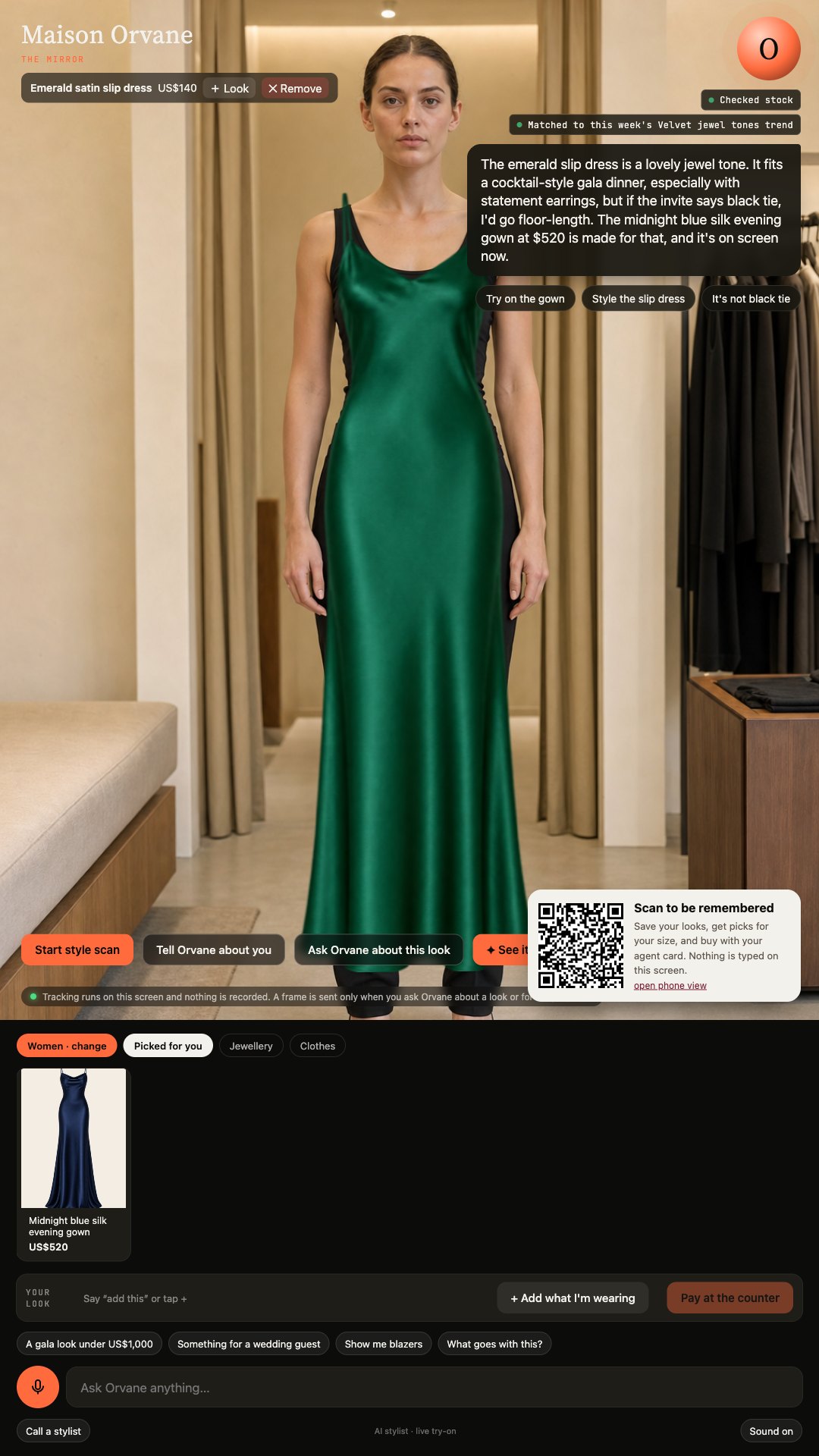
In-store AI for fashion and jewellery falls into four categories. Virtual try-on puts products on a shopper through a camera, usually on a phone or website. Smart mirrors bring that experience to a screen in the store. Clienteling apps help advisors keep relationships with clients. AI stylists answer questions and recommend pieces from stock. They solve different problems at different moments, so the useful question is not which is best, but which moments of the visit you want to cover.
This guide compares the four by what each does, where it sits in the shopper's journey, what data it captures, what it asks of staff and what setting it up involves. Vendor examples are described from their own websites, as of November 2026, and are examples rather than a ranking.
Why compare by category?
Vendors in this space use overlapping words. "Smart mirror", "AI mirror", "virtual try-on", "AI stylist" and "clienteling" can each describe very different products. Comparing categories first makes it easier to see what a given product actually does and what it leaves to other systems or to people.
Shoppers are already comfortable with AI in the buying journey. The 2026 BCG-Altagamma luxury consumer study found that 62% of consumers already expect brands to use AI or generative AI, and that after-sales support, experiential clienteling and product design show essentially no consumer resistance. The question for a retailer is where AI earns its place.
What does virtual try-on do?
Virtual try-on uses a camera to find a face, hand or body and draws a product on it in real time. It is strongest for categories where the product sits on a well-defined point: earrings, necklaces, rings, watches, eyewear and make-up. Some brands and vendors call the apparel version a "virtual fitting room".
Most virtual try-on runs on a shopper's own phone or laptop, on a product page or in an app, which is why it reaches far more people than any in-store screen. The same software can also run on a store tablet or kiosk.
Example. Perfect Corp describes AR and AI try-on for rings, earrings, necklaces, bracelets and watches on its website, including a solution that turns a single 2D product image into a 3D try-on for jewellery and watch brands.
Watch for: how a piece is attached and scaled. A live overlay that follows the shopper is impressive, but jewellery has to hang from the right point at the right size to look worn. We cover this in detail in virtual try-on for fine jewellery.
What do smart mirrors and AR mirrors do?
A smart mirror is a large screen with a camera, placed on the shop floor, in a window or in a fitting room. Products differ widely. Some show digital garments on the shopper as they move; some record a short video so a shopper can compare two looks side by side; some add campaign effects for a launch.
Examples. MemoMi describes its Memory Mirror as AR and AI mirror software for eyewear, beauty and fashion: suggesting frames by face shape, trying on make-up, comparing outfits, changing colours and recording a session to share. ZERO10 describes real-time and photo virtual try-on based on its own 3D body-tracking technology; in October 2023 it built a custom AR mirror for Ugg's New York City flagship, with winter effects shoppers could see on themselves, as Fashion Dive reported.
Watch for: how each product gets onto the mirror. Some approaches need a 3D or digital version of every garment, which suits a capsule or a campaign better than a full seasonal range. Also check whether video is recorded, where it goes and how long it is kept.
What do clienteling apps do?
Clienteling apps are tools for client advisors, usually on a phone or tablet. They bring each client's history, sizes, preferences and conversations into one profile, and let the advisor reach out by text, email or messaging apps, book appointments and see which sales their outreach drove. They are the system of record for relationships.
Examples.
- Tulip describes itself as a clienteling and customer engagement platform, with customer profiles, one-to-one outreach, appointments, mobile point of sale and AI tools for associates. Its site announces a merger with Salesfloor, dated 24 March 2026, forming a combined company under the Tulip brand.
- Endear describes a retail CRM and clienteling platform that gathers purchase history, sizes, preferences and past conversations into one profile, with outreach by text, email and WhatsApp. It says it was Shopify Plus's first certified clienteling app.
- Clientbook describes a clienteling app for retail sales teams with a focus on luxury, offering personalised texting, client wish lists, automated reminders and daily AI-suggested actions, and lists jewellery and apparel among its verticals.
Watch for: adoption and coverage. A clienteling app knows what advisors record, and works for the clients advisors already know. Salesforce's Connected Shoppers research reports that only 17% of store associates have access to a unified view of customer data, so the integration with your point of sale and e-commerce systems matters as much as the app.
What does an AI stylist do?
An AI stylist is a conversational assistant that answers styling questions and recommends products. Online, it usually appears as a chat window on the website. In a store, it can be a screen that a shopper talks to, often alongside try-on. A good one answers "does this work for a black-tie dinner in Paris?" with a recommendation from the store's actual stock, at the store's prices, and calls a person when that would help.
Watch for: grounding and brand control. A general-purpose model will describe products you don't sell, invent offers and drift off your brand's tone. Our guide to a brand-safe AI stylist covers the rules and testing that prevent that.
How do the four compare?
| Category | What it does | Where in the journey | Data it captures | Staff role | Typical setup |
|---|---|---|---|---|---|
| Virtual try-on | Draws a product on the shopper through a camera | Discovery and consideration, mostly online | Camera frames, usually processed in the browser or app; try-on and product events | Little or none | Software on product pages or in an app; product images or 3D models per item |
| Smart mirror / AR mirror | Shows products or effects on the shopper on a large in-store screen | In store, browsing, fitting room or window | Camera frames; with some products, recorded video the shopper can share; interaction analytics | Optional; staff may introduce it | Screen and camera hardware, installation, digital versions of products or campaign content |
| Clienteling app | Gives advisors client profiles, outreach, appointments and attribution | Before and after the visit, and during it with an advisor | Contact details, purchase history, sizes, preferences, messages, consent records | Central: advisors use it every day | Software on staff devices; integration with point of sale, e-commerce and CRM; training |
| AI stylist | Answers questions and recommends products in conversation | Consideration and decision, online or in store | Questions asked, products suggested, hand-overs to staff | Takes over when the stylist calls for help | Catalogue, stock and price connection; brand rules and voice; testing |
How do they differ on data and privacy?
The categories carry very different privacy profiles, and legal and privacy teams should review each on its own terms.
- Camera-based tools (try-on and mirrors) process images of people. The key questions are whether anything is recorded, whether anything leaves the device, and whether the system ever recognises the same person again, which would make it biometric identification in many jurisdictions.
- Clienteling apps hold rich personal data on known clients by design. The key questions are consent for messages, access controls, and how clients can see or delete what is kept.
- AI stylists capture what shoppers ask. That is valuable demand data. The key questions are whether conversations are linked to a person, and for how long they are kept.
Our guide to privacy by design for in-store AI covers the GDPR, the EU AI Act, BIPA, the CCPA and signage in more detail.
Which should you choose?
Start from the problem, not the technology.
- More online sales of jewellery, eyewear or beauty: virtual try-on on product pages.
- A launch moment or a window that stops people on Fifth Avenue or Oxford Street: an AR mirror with campaign content.
- More repeat purchases from clients your advisors already know: a clienteling app, well integrated.
- Serving shoppers who browse alone, and learning what they want: an AI stylist with try-on on the shop floor.
Questions to ask any vendor
- What does the camera capture, what is recorded, and what leaves the device?
- What do you need for each product: photos, 3D models or something else, and who makes them?
- How do stock, prices and offers stay current, store by store?
- Who controls what the system says, and how do we test it before launch?
- How does it hand a shopper over to a member of staff?
- How does it connect to our point of sale, e-commerce and CRM, and which system owns follow-up messages?
- What will we be able to measure, and what will we learn about demand?
Can they work together?
Yes, and in a large store they usually should. A typical pattern is try-on and an AI stylist on the shop floor for shoppers on their own, advisors using a clienteling app for the clients they know, and a clear rule about who follows up with whom. The two things to settle early are a single client profile, so a shopper is not known three different ways, and a single owner for messages, so nobody receives three follow-ups for one visit.
Where does Ateliq fit?
Ateliq combines three of these categories in one in-store system: try-on, an AI stylist, and opt-in customer profiles.
- Two screens. A full-length portrait mirror for the shop floor, for dresses, outerwear and full looks, and a landscape counter screen for earrings, necklaces and pendants.
- Try-on from your own photos. Pieces are cut out of the brand's own product photos. Live try-on is for browsing; when a shopper wants to see a look properly, Ateliq makes a photo from the exact catalogue pieces in about half a minute.
- A stylist in your name. The brand names its stylist. It speaks in the brand's voice, follows its rules, suggests only what is in stock in that store at that store's prices, and uses a weekly city trend board only after the brand approves it.
- Opt-in profiles and follow-up. Shoppers who choose to be remembered get a profile with their size, occasions, and what they love and nearly bought. The look goes to their phone by QR code, and Ateliq can tell them when a piece they tried is back in their size.
- Staff stay central. "Call a stylist" brings someone from the floor team over, and shoppers pay at the counter as usual.
- Privacy. Tracking runs on the screen and nothing is recorded; a frame is sent only when the shopper asks the stylist about a look or for a photo.
It is not a replacement for an advisor's clienteling app, and it is not a point-of-sale system. Ateliq is also new: we are taking design-partner pre-orders from a small group of fashion and jewellery brands, who get the first installs and help shape what it does next.
Sources
- BCG-Altagamma, True-Luxury Global Consumer Insights 2026, summary (July 2026)
- Salesforce stat library, Connected Shoppers report (March 2025)
- Perfect Corp, AR virtual ring try-on and image-to-VTO announcement
- MemoMi, Memory Mirror
- ZERO10 platform terms and Fashion Dive on Ugg's AR mirror (October 2023)
- Tulip
- Endear, clienteling
- Clientbook
Questions people ask
What is the difference between virtual try-on and a smart mirror?
Virtual try-on draws a product on a shopper through a camera, usually on their own phone or a product page. A smart mirror is a large in-store screen with a camera that shows products or effects on the shopper on the shop floor, in a window or in a fitting room.
Do AI stylists replace clienteling apps?
No. Clienteling apps are tools for advisors to keep relationships with clients they know, while an AI stylist serves shoppers in the moment, often those browsing alone. Many stores will use both, with one client profile and one owner for follow-up.
Where does Ateliq fit among in-store AI tools?
Ateliq combines try-on, an AI stylist that speaks in the brand's name and opt-in customer profiles on a full-length mirror and a counter screen. It is new and is taking design-partner pre-orders.