What an in-store AI stylist actually does on the shop floor
From the moment a shopper steps up to the mirror to the photo on their phone: the five moments an in-store AI stylist handles, and what stays with your staff.
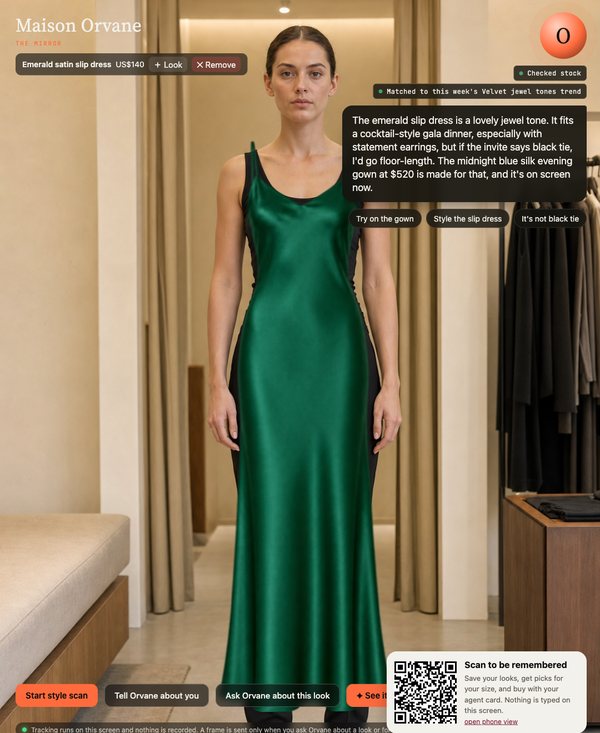
"AI stylist" can mean anything from a chatbot on a product page to a smart mirror that shows a filter. On a shop floor it has to mean something more concrete: a screen a shopper walks up to, that knows the store's stock and prices, puts pieces on them, answers their questions honestly and hands them over to staff when that helps. Here is what that looks like, moment by moment.
1. The shopper steps up
The mirror shows this week's trends for the city and invites the shopper to start. There is no app to download and no account to create. They tap the screen or simply say hello to the stylist by name. Each brand names its own stylist, so the voice on the glass is the brand's, not a software vendor's.
The camera finds them straight away. Tracking runs inside the screen's browser, and a line on the glass says so: nothing is recorded, and a frame is sent only when the shopper asks the stylist about a look or for a photo.
2. They try pieces on
One tap puts a piece on. On the full-length mirror, a dress or a coat follows the shopper as they turn; long styles fall to the ankle, and tops sit at the shoulder. At the counter, the screen is close up for earrings, necklaces and pendants.
For a photo that looks real, the stylist makes one from the exact catalogue pieces. It takes about half a minute, and it is the moment most shoppers decide.
3. They ask the stylist
This is where a stylist earns the name. A shopper asks, "Is this right for a gala dinner on Friday?" A useful answer has to be grounded in three things:
- The store's own stock. The stylist only suggests pieces that are in stock in that store, at that store's prices and offers.
- The occasion and the shopper. A slip dress works for cocktail dress codes; for black tie, the stylist points to a floor-length gown instead and says why.
- This week's trends, from a trend board the brand has approved, never from guesswork.
The stylist answers out loud in a few sentences and offers one-tap next steps: try the gown, keep this look, see it with different earrings.
4. They see it for real
When the shopper wants to see the look properly, the stylist makes the photo: the shopper in the exact pieces, with real light and drape, ready to keep.
5. They take it home
A QR code on the screen sends the look to the shopper's phone: the photo, the pieces and the prices, with a caption ready to share. Shoppers who choose to be remembered get picks for their size next time. They pay at the counter as usual.
What stays with your staff
An in-store stylist is not a replacement for people on the floor. It handles the moments staff rarely have time for, such as the fifth earring someone wants to try or the question at the end of a long day, and it knows when to step back.
- "Call a stylist" on the screen brings someone from the floor team over.
- Payment, fitting and alterations happen where they always have, with your team.
- The brand decides what the stylist may say: its rules on returns and offers, the trends it uses, and the tone of voice.
Why it matters
Shoppers who can try more pieces, get an honest answer and leave with a photo come back with a clearer idea of what they want. And for the brand, every try-on and every question is a signal about what shoppers want, which no till receipt captures.