Top 10 agentic AI use cases for jewellery design in 2026
Ten ways AI agents help jewellery design teams, from demand-led briefs and designing to a gold weight to CAD checks, stone layouts, karigar job cards and provenance.
The ten agentic AI use cases that matter most to jewellery design teams in 2026 are: briefs from trends and unmet demand, designing to a weight and a price, concept renders in the house style, preparing CAD and 3D prints for casting, stone layouts and sourcing, bridal and regional collections, bespoke commissions with the client, testing concepts with customers before casting, job cards for the karigar and the workshop, and compliance, provenance and originality. In each one an agent reads, calculates and drafts, and a designer, a master craftsman or the client decides.
This guide is for design heads, CAD teams, merchandisers and owners at jewellery houses: a temple-jewellery workshop in Coimbatore or Nagercoil, a kundan and polki house in Jaipur or Bikaner, a diamond jeweller with cutting in Surat and stores in Dubai, or a fine-jewellery brand designing in London or New York. For every use case we set out the job today, what an agent does, where a person approves, the data it needs, how to measure it and the risks. Where Ateliq, our own product, does the job today we say so. Where it does not, we describe where the market is heading.
What does "agentic" mean in jewellery design?
An AI agent reads, decides and acts within limits a person sets. A chatbot can describe a jhumka. An agent can take a brief for a lighter 22K jhumka under a price ceiling, read today's rate, work out how much gold that allows, draft concepts that fit it, and hand them to the CAD team with the weight budget written on each.
The limits in jewellery design come from metal, stones and hands. Gold is priced by the gram, stones by the carat and the grade, and a design that cannot be cast, set or finished by the workshop is only a picture. So the rule throughout this guide: agents calculate, check and draft; designers choose; the workshop decides what can be made; and nothing reaches a customer without a person's approval.
The ten at a glance
| Use case | What the agent does | Who approves | In Ateliq today? |
|---|---|---|---|
| 1. Briefs from trends and unmet demand | Turns trend boards and repeated requests into design briefs | Head of design | Yes |
| 2. Designing to a weight and a price | Works out the metal and stone budget a price allows | Designer and merchandiser | Market |
| 3. Concept renders in the house style | Drafts concepts from a sketch, an archive piece or a motif | Designer | Partly |
| 4. CAD and 3D printing for casting | Checks and prepares models for printing and casting | CAD lead and workshop | Market |
| 5. Stone layouts and sourcing | Drafts layouts; matches stones from stock and suppliers | Gemmologist and buyer | Market |
| 6. Bridal and regional collections | Builds sets from a library of traditions and forms | Design head | Market |
| 7. Bespoke commissions | Turns a client's wishes into options, renders and a quote | The client and the designer | Market |
| 8. Testing concepts before casting | Shows approved concepts to customers; counts tries and votes | Design and merchandising | Yes |
| 9. Job cards for the karigar | Drafts job cards; tracks metal issued and returned | Workshop manager | Market |
| 10. Compliance, provenance and originality | Checks purity plans, disclosure and records; flags close matches | Design director, compliance | Partly |
1. Briefs from trends and unmet demand
The job today. Designers work from trade fairs, competitors' windows, Instagram and what the owner hears at the counter. What customers asked for and did not find, such as a lighter necklace for daily wear or a rose-gold mangalsutra in a modern form, rarely reaches the design desk in a usable form.
- What the agent does: reads fashion and jewellery press, the brand's social accounts and what customers tried and asked for in each city; groups repeated requests; and drafts a brief: the evidence, the occasion, the metal and purity, the price band and what was offered instead.
- Who approves: the head of design picks the briefs worth pursuing.
- Data it needs: a consistent record of requests and try-ons, the current range, and sales by weight band and price.
- How to measure it: briefs taken forward, and how pieces designed from briefs sell against similar pieces in their first months.
- Risks and guardrails: fine jewellery has few, large sales; one family's request is not a trend. Set a threshold and read over weeks.
In Ateliq today. Every Monday the trend scout drafts trends for each store city from fashion press, the brand's connected social accounts and what that city's shoppers tried, and a person approves the board. "Asked for, not carried" groups what shoppers asked for that a store does not stock. Every Tuesday the Designer drafts up to three concepts, only where shoppers asked for something three times or tried a piece five times without buying, and a person approves every concept.
2. Designing to a weight and a price
The job today. In gold jewellery the price is mostly the metal, so a design is really a weight. When rates rise, customers ask for lighter pieces that still look full, and designers rework hollow forms, open work and thinner sections by trial and error.
- What the agent does: takes a target price, today's confirmed rate, the purity and the making charge, and works out the metal and stone budget; then checks each concept's estimated weight against it and flags pieces that will land outside the band.
- Who approves: the designer and the merchandiser agree the band; the workshop confirms the weight after the first casting.
- Data it needs: confirmed metal rates, making-charge rules, past pieces with their actual weights, and the CAD model's volume where one exists.
- How to measure it: difference between estimated and actual weight, and the share of new pieces that land in their price band.
- Risks and guardrails: a light piece that bends or breaks. Weight targets must sit inside the workshop's minimum thickness and strength rules, never below them.
Where the market is heading. Ateliq prices finished pieces from net weight, purity, today's confirmed rate, making charges and stones, but it does not set weight budgets for designs. We expect design tools to bring the pricing engine forward, so a designer sees a piece's price at today's rate while drawing it.
3. Concept renders in the house style
The job today. A designer sketches by hand; a CAD artist models; a render takes days. Early on, the team wants many options quickly, in the house's own forms: its granulation, its kundan settings, its way with a clasp.
- What the agent does: starts from something real (a hand sketch, an archive piece, a motif from a temple border or a textile) and drafts concepts in the house style, shown from more than one angle and on a person, with notes on likely metal and stones.
- Who approves: a designer chooses, edits or rejects every concept.
- Data it needs: the house's archive with good photos, its signature techniques written down, and what it never does.
- How to measure it: days from brief to first review, concepts surviving review, and CAD rework per approved design.
- Risks and guardrails: renders that cannot be made. Every concept should go to CAD and the workshop before anyone commits to it, and AI-made images should be labelled.
Where Ateliq is today. Ateliq's Designer drafts concepts in the brand's style where demand shows a gap, a person approves every one, and the photographer can show jewellery on a model from the brand's own photos. Its four-view design drawings (front, back, detail and on a model) are built for garments. Where the market is heading: concept agents that know a house's techniques and hand clean starting points to CAD.
4. CAD and 3D printing for casting
The job today. CAD designers model each piece, then prepare it for resin or wax printing and casting: wall thickness, sprues, shrinkage, prong strength. Errors show up as failed castings and wasted metal.
- What the agent does: checks each model against the workshop's rules (minimum thickness, prong and gallery sizes, ring-size variants), estimates metal weight per purity, prepares print files and flags problems before printing.
- Who approves: the CAD lead and the workshop sign off every file before it is printed or cast.
- Data it needs: the workshop's rules per metal and alloy, printer and casting settings, and the results of past castings.
- How to measure it: failed castings, reprints, and hours from approved design to casting.
- Risks and guardrails: an agent that changes a model silently. It should flag and propose, and the CAD designer should make the change.
Where the market is heading. Ateliq does not do CAD or casting. We expect CAD packages to add checking agents first, because the rules are clear and the cost of a failed casting is easy to count.
5. Stone layouts and sourcing
The job today. A gemmologist or setter works out how many stones of which size, shape and grade a design needs; buyers then match them from stock or suppliers. Colour matching for emeralds, rubies or polki takes an expert eye and many trips to the safe.
- What the agent does: drafts a stone layout from the design (counts, sizes, total carat weight), checks it against stock, and drafts enquiries to approved suppliers for the rest, with the grading or certificate requirements written in.
- Who approves: the gemmologist approves every layout and match; the buyer approves every purchase.
- Data it needs: stone stock with grades and certificates, supplier lists, and past layouts.
- How to measure it: days to a complete stone set, stones bought per design against plan, and rejected matches.
- Risks and guardrails: an agent cannot judge colour or clarity from a photo. It can only work from grading records and pass on what suppliers declare, including whether a stone is natural or laboratory-grown.
Where the market is heading. Ateliq does not plan stones or buy them. Stone-planning agents that read grading reports and stock will be the first step; matching by eye stays with experts.
6. Bridal and regional collections
The job today. Bridal jewellery in India follows the customs of each community and region: a Tamil bride's temple set, a Bengali bride's shakha-pola and gold, a Marwari bride's kundan and polki, a Malayali bride's palakka and mullamottu malas. Designing a bridal line means knowing which pieces belong together, and that knowledge lives in a few senior heads.
- What the agent does: keeps a library of traditional forms and set compositions written up by the house's own experts, and drafts bridal sets for a region and budget: which pieces, in what weights, with options for a lighter or a heavier set.
- Who approves: the design head, ideally with a senior from the community the collection serves.
- Data it needs: the house's archive, tagged by region, community and piece type; sales by region; and the experts' notes.
- How to measure it: bridal sets sold as sets, average bridal order value, and time to build a new regional line.
- Risks and guardrails: getting a custom wrong is worse than leaving it out. The library must be written by people who know, never inferred by a model, and the agent should say when it is unsure.
Where Ateliq is today. Ateliq's cataloguer suggests tags from product photos, including Indian jewellery terms, and a person accepts each one; head office curates bridal sets of two to eight pieces that a shopper can try in one tap. It does not design bridal collections. Where the market is heading: design agents built on a house's own written knowledge of traditions.
7. Bespoke commissions with the client
The job today. A couple wants an engagement ring, or a family wants grandmother's necklace remade. The designer meets them, sketches, quotes, revises, and the back-and-forth runs for weeks over WhatsApp and email.
- What the agent does: turns what the client said and saved into a short brief, drafts a few options with renders, estimates weight and price at today's rate, and keeps the thread of every change and approval in one place.
- Who approves: the client approves the design and the quote; the designer and the workshop confirm what can be made.
- Data it needs: the client's brief and references, sizes, budget, the house's pricing rules, and for remakes, the tested weight and purity of the old piece.
- How to measure it: rounds of revision, days from first meeting to approved design, and commissions won.
- Risks and guardrails: quotes made on a moving rate. Show the rate's time on every estimate and confirm the final price on a fresh rate.
Where Ateliq is today. Shoppers can book bridal and high-jewellery appointments from their phone, and opted-in customers' sizes, occasions and saved pieces are remembered for the next visit. Ateliq does not run bespoke commissions. Where the market is heading: commission agents that keep the brief, renders and quote together for the designer.
8. Testing concepts with customers before casting
The job today. Houses cast samples, show them to a few trusted customers and the store teams, and decide. Each sample costs metal, labour and weeks.
- What the agent does: shows approved concepts to customers, clearly marked as not in store yet, lets them try a concept on screen and vote, and reports tries and votes by city against comparable pieces in stock; it can also draft a shoot of the concept on a model.
- Who approves: design approves which concepts are shown; design and merchandising decide what to cast.
- Data it needs: approved concept images, a place to show them, and stocked pieces to compare against.
- How to measure it: tries and votes per concept against comparable stock, and later, sales of cast concepts.
- Risks and guardrails: votes rank concepts; they do not set quantities. Never let a customer think a concept can be bought today.
In Ateliq today. Approved design concepts appear on the mirror as "New ideas", marked "not in store yet". Shoppers try them on and vote, and the brand exports the results for its design team. The photographer makes product shoots from the brand's own photos, including jewellery on a model.
9. Job cards for the karigar and the workshop
The job today. In much of Indian jewellery, pieces are made by karigars in in-house workshops or by job workers outside. Each job needs a card: the design, the weights, the stones, the deadline, and a careful account of metal issued and returned, because every gram matters.
- What the agent does: drafts a job card from the approved design (drawing, weight target, purity, stones, finish, deadline), tracks metal issued, returned and lost at each stage against the agreed allowance, and flags jobs that run late or over.
- Who approves: the workshop manager issues every job and signs off every return of metal.
- Data it needs: approved designs, the workshop's allowance rules per process, and weighing records.
- How to measure it: metal loss against allowance, on-time jobs, and rework.
- Risks and guardrails: metal accounts are money. The agent records and flags; it never adjusts a weight, and every figure comes from a scale.
Where the market is heading. Ateliq does not run workshops. Job-work tracking is a strong first agent for Indian manufacturers, because the records already exist on paper and in ledgers.
10. Compliance, provenance and originality
The job today. A new design has to meet more rules than ever: purity that can be hallmarked (in India, BIS hallmarking of gold has been mandatory since June 2021 in the districts it covers), clear disclosure of laboratory-grown diamonds (the US FTC's guidance asks for a word like "laboratory-grown" right before "diamond"), and responsible sourcing, under the Kimberley Process for rough diamonds, the OECD due diligence guidance for minerals including gold, and the Responsible Jewellery Council's Code of Practices for its members. Then there is originality: is the new design too close to someone else's?
- What the agent does: checks each design's planned metal and purity against what can be hallmarked, attaches the sourcing records suppliers provided, writes the disclosure text for stones, and compares the design with the house's archive, flagging close matches; it also keeps a record of the human work in each design.
- Who approves: the design director and compliance, with legal advice for anything flagged.
- Data it needs: supplier declarations and certificates, the archive, and the rules of each market the piece will be sold in.
- How to measure it: designs with a complete record, flags raised before casting, and disputes.
- Risks and guardrails: an agent can only pass on what suppliers declare; it never fills a gap with a guess. On ownership, the US Copyright Office has said prompts alone do not give enough control for authorship, while human selection, arrangement and changes can be protected, and in the EU, Article 50 of the AI Act has required AI-generated images to be marked since 2 August 2026. This is not legal advice.
Where Ateliq is today. At the counter, Ateliq shows each piece's metal, purity, karat, weights, stones and hallmark, and for BIS pieces explains how to check the HUID in the BIS CARE app. Every uploaded image carries a rights statement, and a shopper's photo never becomes a brand asset. It does not check sourcing records or run similarity searches. Where the market is heading: provenance records that start at the design desk and travel with the piece to the counter.
How to start in 90 days
Choose one use case that feeds the design desk and one that saves metal or time in the workshop. For a retailer-designer, briefs from demand (1) and testing concepts (8) share data. For a manufacturer, designing to weight (2) and job cards (9) pay back fastest.
- Days 1 to 30: write down what you know. Photograph and tag the archive, write the house's techniques and rules on a page, collect actual weights for recent pieces, and agree who approves what. Pick two measures, such as estimated against actual weight, or days from brief to approved design, and take a baseline.
- Days 31 to 60: run beside the team. Let the agent draft briefs, budgets or job cards in parallel with the usual process, and check every draft.
- Days 61 to 90: hand over part of the work. Move the drafts into the real process, test the best concepts with customers, compare with the baseline, and decide: keep, change or stop.
For turning requests into briefs, see from demand signals to new designs; for the counter, see the companion piece on agentic AI use cases for jewellery retail.
Take the playbook, or see it live
All 40 use cases from this series, across jewellery design, jewellery retail, fashion design and fashion retail, are in one free guide with a readiness checklist, a 90-day pilot plan and a vendor scorecard: The Agentic AI Playbook for Fashion and Jewellery. To try jewellery on at the counter and see metal-rate pricing, open the live demo.
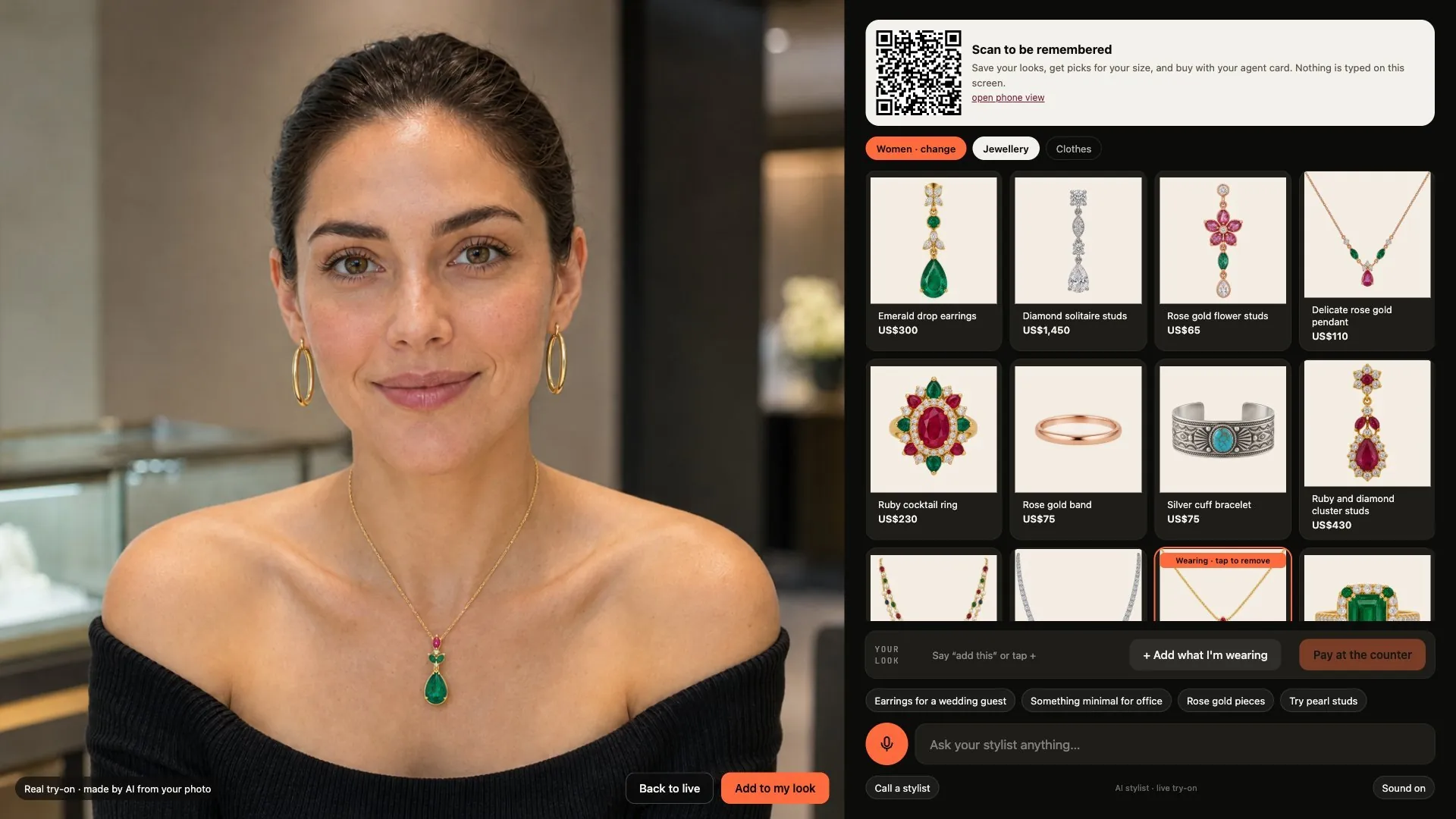
The image at the top of this article is from our fictional demo store. The model and the try-on photo are AI-generated.
Sources
- Bureau of Indian Standards, brief on the hallmarking scheme
- US Federal Trade Commission, In the Loupe: advertising diamonds, gemstones and pearls
- Kimberley Process: what is the Kimberley Process?
- OECD Due Diligence Guidance for Responsible Supply Chains of Minerals from Conflict-Affected and High-Risk Areas, third edition
- Responsible Jewellery Council, Code of Practices
- US Copyright Office, Copyright and Artificial Intelligence, Part 2: Copyrightability
- European Commission, transparency obligations under Article 50 of the AI Act
Questions people ask
What is agentic AI in jewellery design?
AI agents that read, calculate and draft within limits a person sets. In jewellery design, an agent can turn repeated customer requests into a brief, work out the gold weight a price allows at today's rate, check CAD files for casting and draft job cards, while designers, the workshop and the client decide.
What are the top agentic AI use cases for jewellery design?
Briefs from trends and unmet demand, designing to a weight and a price, concept renders in the house style, CAD and 3D printing for casting, stone layouts and sourcing, bridal and regional collections, bespoke commissions, testing concepts before casting, job cards for the karigar, and compliance, provenance and originality.
Can AI help design lighter gold jewellery?
Yes. Given a target price, today's confirmed rate, the purity and the making charge, an agent can work out the metal budget and flag concepts that will land outside it. Weight targets must stay within the workshop's minimum thickness and strength rules.
Can AI judge gemstone quality for a design?
No. An agent can draft a stone layout and match stones from grading records and supplier declarations, including whether a stone is natural or laboratory-grown, but colour and clarity matching stays with a gemmologist.
What sourcing rules should a jewellery design record cover?
Common frameworks include the Kimberley Process for rough diamonds, the OECD due diligence guidance for minerals including gold, and the Responsible Jewellery Council's Code of Practices for its members. An agent can attach the records suppliers provide but should never fill a gap with a guess.