Top 27 fashion AI companies to engage in 2027
27 fashion AI companies compared for 2027, from design, trends and planning to content, try-on, fit and the store: features, prices and what to check.
These are 27 fashion AI companies worth talking to before you set your 2027 plans, from design and trend forecasting to planning, product content, try-on, fit and the store. Each one is described from its own website, announcements and press coverage, checked on 12 November 2026, with links for every claim and a screenshot of its site taken that day.
Nagent publishes this list. Ateliq is Nagent's industry solution for fashion and jewellery retail, so we have put it first. The other 26 are grouped by the job they do, from the first sketch to the shop floor, and the order inside each group is not a ranking.
Why 2027 is a different buying year
Two things changed in 2026. First, fashion AI moved from tools that answer to agents that act. Raspberry AI launched an agentic platform that carries a brief from moodboard to product page, Centric Software added agents to PLM, Lily AI's Lily Max republishes product data once a person signs off, and Vêtir's agentic checkout places an order inside a chat.
Second, the market consolidated. Perfect Corp left the New York Stock Exchange in October 2026, Tulip merged with Salesfloor, M2P Fintech bought Vue.ai's maker, Heuritech joined Luxurynsight, Cala became Mercer, and two companies we planned to include are no longer sold as they were. So the useful questions for 2027 are what an AI may do on its own, who approves it, and who you will be contracting with next year.
How we picked and compared
Every company had to be built for, or sold to, fashion, footwear or jewellery brands and retailers; be on sale today; have a working website and public activity in 2025 or 2026; and describe its product publicly. We checked each site loaded on 12 November 2026 and looked for acquisitions, renames and shutdowns.
We left out Zyler, whose site now redirects to its parent's photo-editing software and whose business site leads to a page saying Bridely has closed; Syte, now sold as Syte by Nayax, whose own site was last updated in 2024; and Lalaland.ai, acquired by Browzwear in 2025. We also left out general photo editors that are not built for fashion.
In the table, ✓ means the company documents the feature on its own pages or in its announcements, ○ means a partial or limited version, and – means we found no public evidence, which is not the same as saying the company cannot do it. Customers are named only where the company or a reputable publication names them. Prices are as published on 12 November 2026. Screenshots were captured on that day through the Oxylabs Web Scraper API with JavaScript rendering, and are shown as captured, so some show cookie banners, pop-ups or images that had not finished loading.
The 27 compared
| Company | Design | Trends | Try-on | Fit and size | Planning and demand | Search and discovery | Content and photos | In store | Follow-up and CRM | Agents that act | India |
|---|---|---|---|---|---|---|---|---|---|---|---|
| 1. Nagent AI (Ateliq) | ✓ | ✓ | ✓ | ○ | ○ | ✓ | ✓ | ✓ | ✓ | ✓ | ✓ |
| 2. Raspberry AI | ✓ | ○ | ✓ | – | – | – | ✓ | – | – | ✓ | – |
| 3. Centric Software | ✓ | ✓ | – | – | ✓ | – | ✓ | – | – | ✓ | – |
| 4. Mercer (formerly Cala) | ✓ | – | – | – | – | – | ○ | – | – | – | – |
| 5. The New Black | ✓ | – | ✓ | – | – | – | ✓ | – | – | ○ | – |
| 6. WGSN | – | ✓ | – | – | ✓ | – | – | – | – | – | ✓ |
| 7. Heuritech | – | ✓ | – | – | ✓ | – | – | – | – | – | – |
| 8. Stylumia | – | ✓ | – | – | ✓ | – | – | – | – | ○ | ✓ |
| 9. Trendalytics | – | ✓ | – | – | ✓ | – | – | – | – | – | – |
| 10. Increff | – | – | – | – | ✓ | – | – | ✓ | – | ○ | ✓ |
| 11. Nextail | – | – | – | – | ✓ | – | – | ✓ | – | – | ✓ |
| 12. Lily AI | – | – | – | – | – | ✓ | ✓ | – | – | ✓ | – |
| 13. Vue.ai | – | – | ✓ | – | ○ | ✓ | ✓ | – | – | – | ✓ |
| 14. Botika | – | – | – | – | – | – | ✓ | – | – | – | – |
| 15. Claid.ai | – | – | ○ | – | – | – | ✓ | – | – | – | ○ |
| 16. FlixStock | – | – | – | – | – | – | ✓ | – | – | – | ○ |
| 17. Perfect Corp | – | – | ✓ | – | – | – | ✓ | ✓ | – | ○ | ✓ |
| 18. DRESSX | – | – | ✓ | ○ | – | ✓ | ✓ | ○ | – | ○ | – |
| 19. Veesual | – | – | ✓ | – | – | ○ | ✓ | – | – | – | – |
| 20. mirrAR | – | – | ✓ | – | – | ✓ | – | ✓ | ✓ | ✓ | ✓ |
| 21. ZERO10 | – | – | ✓ | – | – | – | – | ✓ | – | – | – |
| 22. True Fit | – | – | ✓ | ✓ | ○ | ✓ | – | – | – | ○ | – |
| 23. Fit Analytics | – | – | – | ✓ | – | ✓ | – | – | – | – | – |
| 24. Bold Metrics | – | – | – | ✓ | ○ | – | – | – | – | ○ | – |
| 25. 3DLOOK | – | – | – | ✓ | ○ | – | – | ✓ | – | – | – |
| 26. Tulip | – | – | – | – | – | – | – | ✓ | ✓ | ○ | – |
| 27. Vêtir | – | ○ | ✓ | ✓ | – | ✓ | – | – | ✓ | ✓ | – |
"Agents that act" means the company describes AI that carries out steps, not only answers or recommends. "India" means an office, a named customer or a partner in India. Each entry below explains its marks.
Our product: the store and the agents behind it
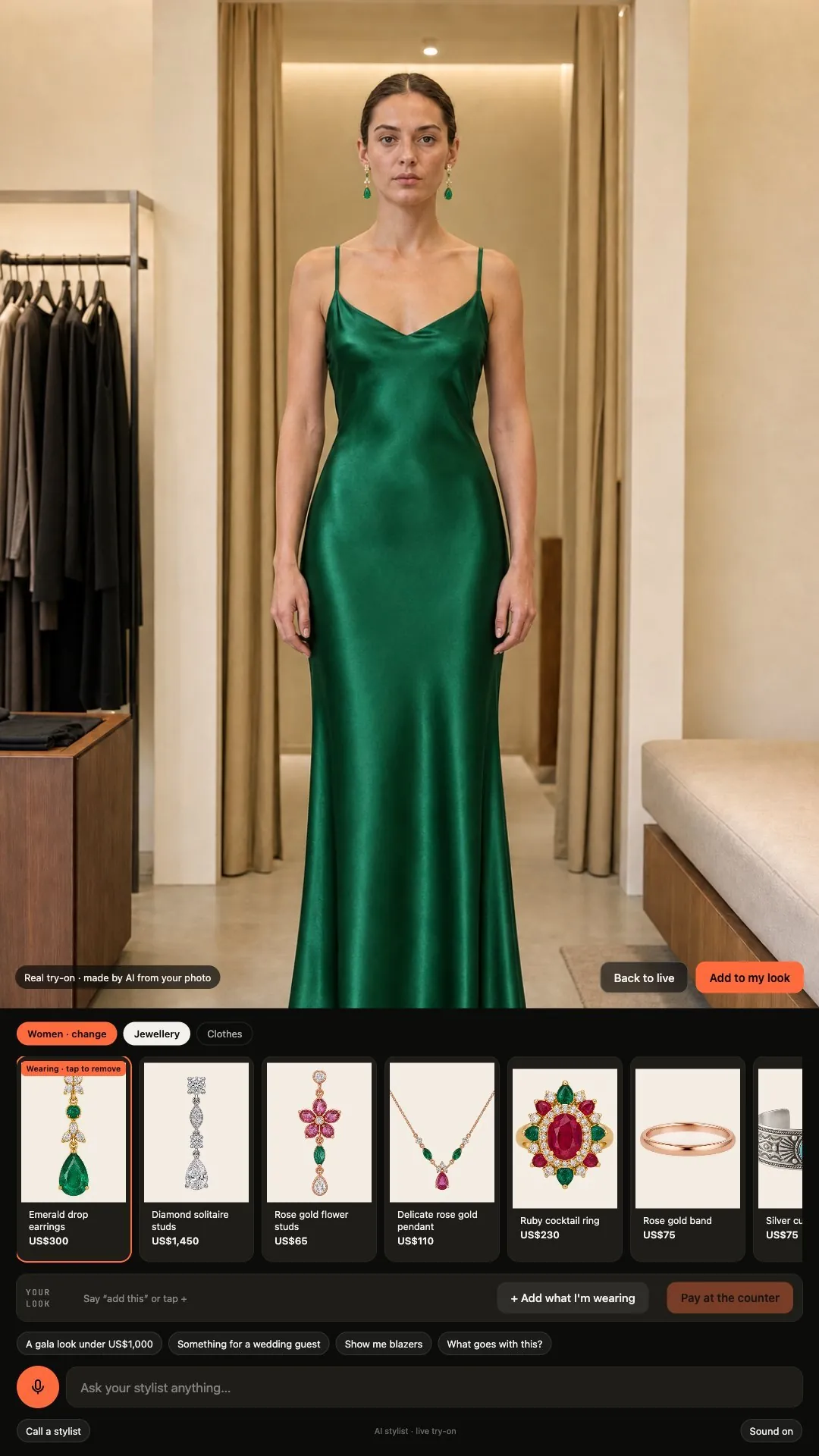
1. Nagent AI (Ateliq): an in-store AI stylist with twelve agents behind the glass (our product)
Nagent AI is an agent platform, and Ateliq is its industry solution for fashion and jewellery retail. In the store, a full-length mirror and a counter screen let shoppers try on 21 kinds of piece live, from dresses, sarees and lehengas to jhumkas, rings, bangles and watches, and ask a stylist named by the brand. The stylist answers from that store's own stock, sizes, prices and offers. Jewellery is priced from today's metal rate, weight, purity and making charges, with the breakdown on screen. Buying creates a hand-off code that links the visit and the associate who helped to the sale, wherever the shopper finishes it.
Behind the glass, twelve agents work on a weekly rhythm: a retail lead, a trend scout, a retail analyst, a merchandise analyst, a fashion strategist, a designer, a marketer, a clienteling agent, a cataloguer, a photographer, a market watch agent and a FabFit charts agent. They draft trend boards for each city, store reports, design concepts, product shoots, campaigns and follow-ups, and a person on the brand's team approves anything a shopper or the public will see.
The newest feature is design with your cloth. In a handloom or fabric store, the shopper scans a cloth's tag at the mirror and Ateliq shows three dresses made from that exact cloth, keeping its weave, motifs, colours and border. She can send a picture of a dress she likes from her phone through a QR code; it lends the shape only and is deleted when her visit ends. She then sees one design on herself, and Ateliq works out the cloth, stitching and days and sends the design to the store's tailor. For head office, the Designer draws new designs from a print, a sample or the week's approved trends in four views (front, back, a detail and on a model), and a person approves every design before any shopper sees it.
- Live try-on on a mirror and a counter screen, plus a photo-real image made from the exact catalogue pieces, deleted after 30 minutes
- Opt-in follow-ups by email or WhatsApp, at most two a week, from templates the brand approved
- Weekly trend board per city, weekly store reports, and "asked for, not carried" requests for planning
- Catalogue and stock from Shopify, WooCommerce, Adobe Commerce, SAP S/4HANA, Unicommerce, a REST API, CSV or SFTP; Razorpay and Stripe pay links; Klaviyo or any CRM through a signed webhook
- Camera consent first, tracking on the screen, nothing recorded; it never infers body shape, race, ethnicity or weight
Runs in: India and the United States · Security: Nagent is ISO/IEC 27001:2022 certified and has a SOC 2 Type II report · Pricing: on request; software available now, Mirror and Counter on pre-order
Best for: fashion, jewellery, handloom and fabric brands with their own stores that want the visit to be as measurable as their website, and agents whose work a person approves.
Watch for: Ateliq is new. The software is available now and the Mirror and Counter are on pre-order, but there are no published customer results yet. The screens never take payment, it does not write back to your POS or ERP, and voice commands are in English. Try the fictional demo store at demo.ateliq.co.
Sources: Ateliq product page, ateliq.co, FabFit.
Design and product creation
2. Raspberry AI: generative design, now run by agents
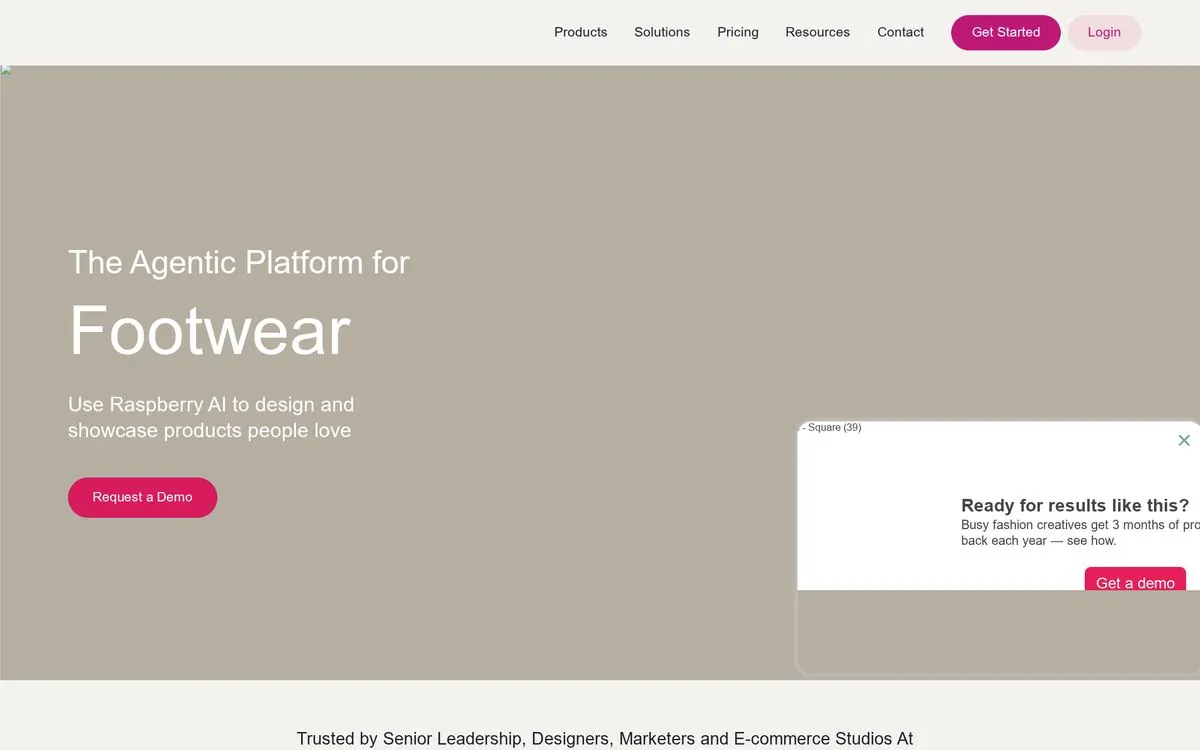
Raspberry AI turns sketches, prompts and references into photo-real designs, prints, multi-view renders and on-model images for apparel, footwear, bags and jewellery. In September 2026 it launched an agentic platform that carries a brief, such as a men's denim range, through moodboards, tech designs, lookbooks and product-page assets, with people reviewing the work. SKIMS, ALO and Savage X Fenty were named in that announcement, and Adidas, Levi's and Columbia appear on its homepage.
- Sketch to render, multi-view generation, and print and pattern generation with seamless repeats
- On-body try-on, off-body product shots and a video studio
- Custom models trained on a brand's own work, for enterprise customers
HQ: New York · Funding: $24M Series A led by a16z, January 2025 (TechCrunch) · Pricing: published: free (20 credits), Individual $49, Basic $198 and Pro $298 per user per month, Enterprise custom
Best for: design and creative teams that want generative design and the imagery that follows it in one tool.
Watch for: the agent workflow launched in September 2026, so ask for references on the whole flow, not only image generation. Its speed and sample-cost figures are its own, with no published method.
Sources: raspberry.ai, pricing, Unite.AI, TechCrunch.
3. Centric Software: generative design and agents inside PLM
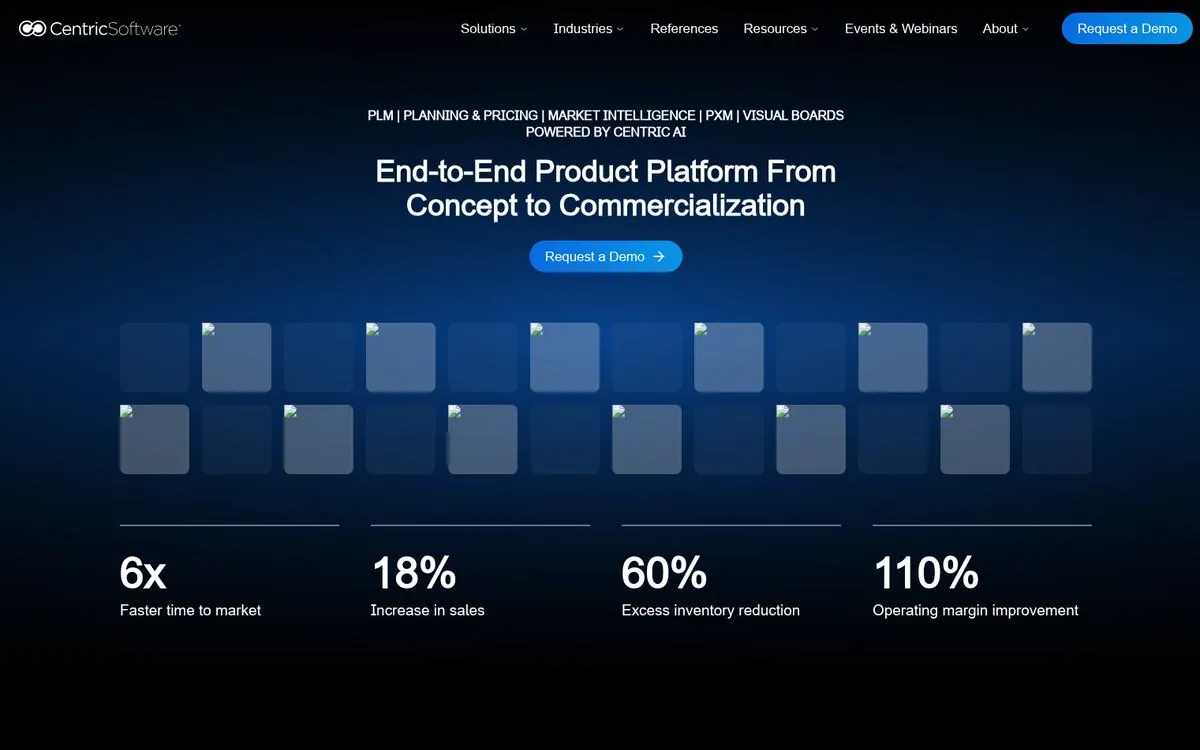
Centric Software makes product lifecycle management (PLM), planning, pricing and market-intelligence software for fashion, footwear, outdoor and other consumer goods. Centric AI Studio, unveiled in May 2026, generates sketches, concepts, colourways and on-model imagery inside the product workflow, with GANT and g-lab named as users. In September 2026 it announced Centric AI: a Companion that can "trigger actions in natural language", an MCP connection for outside AI systems, and agents that "hand off entire tasks end to end", such as a BOM and Tech Pack Agent that turns a sketch or supplier document into a bill of materials.
- Centric PLM, Planning and Pricing, Visual Boards and PXM (product information and digital assets)
- Centric Market Intelligence on consumer trends, competitor offers and pricing
- AI Studio for generative product ideas and visual content
HQ: Campbell, California · Founded: 1998 (Wikipedia) · Ownership: a subsidiary of Dassault Systèmes, which took a majority stake in 2018 · Pricing: on request
Best for: brands that run, or are replacing, a PLM and want AI inside the system that already holds their product data.
Watch for: the agents are new, so ask which are live for your modules and how approvals work inside your PLM workflows. The time and margin figures in the release are Centric's own.
Sources: Centric AI release, September 2026, Retail IT Insights on AI Studio, centricsoftware.com.
4. Mercer (formerly Cala): AI design to production for independent labels
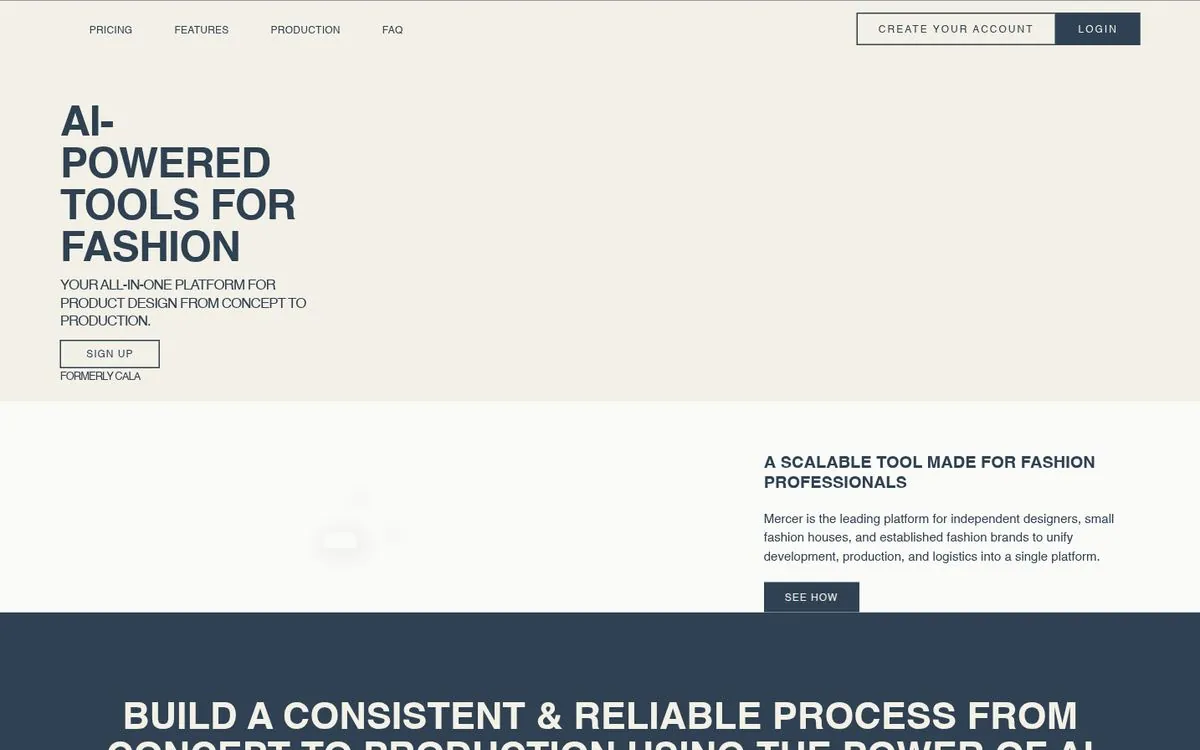
Cala now trades as Mercer: ca.la redirects to mercer.design, which says "Formerly Cala". It combines an AI designer (text to image, product variations and an AI paintbrush), custom models trained on a brand's own references, comments, tasks and print-ready exports, and, on its Enterprise plan, production oversight through 50+ manufacturers and shipping to 140+ countries. Mercer says it is model-agnostic, uses a mix of Flux and Stable Diffusion, and does not use customer data to train its foundational models or other customers' models.
HQ: New York · Founded: 2016, as Cala (AlleyWatch) · Funding: $3M seed extension, 2020 (GlobeNewswire) · Pricing: published: Designer $19, Studio $69 and Studio Pro $159 a month, Enterprise from $499
Best for: independent designers and small labels that want AI design, collaboration and optional production in one low-cost tool.
Watch for: we found no dated announcement of the rename, so check which company you contract with. Production is on the Enterprise plan only, and the factories' countries are not named.
Sources: mercer.design, pricing, production, CB Insights.
5. The New Black: a low-cost AI fashion studio
The New Black designs garments from prompts, sketches or fabric, puts them on AI models, drafts tech packs with flats, measurements and a bill of materials, and publishes images to Shopify, Instagram, TikTok, Pinterest, YouTube and X. It offers bulk generation of up to 30 products from one brief, try-on, an AI stylist, a REST API, a Shopify app and an MCP server for creating and publishing from an AI assistant.
Founded: March 2023 by Antoine Verhille (about page) · Team: New York and Paris, per FashionUnited · Funding: not public · Pricing: published: Starter $15, Pro $35, Business $65 and Enterprise $195 a month
Best for: small brands and Shopify sellers that want design, product-page images and tech packs at a low monthly price.
Watch for: it says more than 1,000 brands use it but names none. Its pricing lists "AI agent credits" without describing what the agents do or how they are approved. Check data and IP terms before you upload your archive.
Sources: thenewblack.ai, pricing, about.
Trend forecasting and demand sensing
6. WGSN: expert forecasts with AI buying tools
WGSN combines expert forecasts with data and AI tools for design, buying and marketing teams across fashion, beauty, interiors, food and drink and consumer tech. Its Fashion Buying platform includes an Assortment Builder that tests a SKU list against next season; a Catwalks AI Dashboard (September 2026) brings runway data within 24 hours; and an Intelligence API feeds WGSN data into a client's own AI tools. In September 2025 it took Fashion Buying to Asia, including India.
HQ: London · Operating since: 1998 · Ownership: funds advised by Apax since February 2024 (LSE news) · Pricing: subscription, on request · India: Fashion Buying sold in India; business development in South Asia with Technopak (Fibre2Fashion)
Best for: large brands and retailers that want broad, expert-led direction and AI checks on next season's assortment.
Watch for: modules are sold separately, so check which your subscription covers. The group is broadening beyond fashion; it bought IWSR, a drinks data company, in 2025.
Sources: wgsn.com, Fashion Buying, TechNode Global, LSE news on the Apax deal.
7. Heuritech: trend forecasts from social media images
Heuritech reads millions of social media images with computer vision to measure and forecast demand for colours, prints, fabrics and shapes, up to 24 months ahead, across 16 regions, four age groups and three audience panels from trendsetters to mainstream. It detects more than 2,000 product attributes and is sold as a platform, an API and reports. Its success stories name New Balance, Dior, Louis Vuitton, Paco Rabanne, Wolverine and Sperry.
HQ: Paris · Founded: 2013 · Ownership: part of Luxurynsight since late 2024 (Heuritech) · Pricing: three tiers, on request
Best for: brands that want attribute-level, image-based trend signals to size design and buying bets.
Watch for: its homepage gives its forecast accuracy as both 92% and 91%, so ask how it is measured. Since the acquisition, confirm the contracting company and roadmap.
Sources: heuritech.com, pricing, Luxurynsight announcement, 2019 Series A.
8. Stylumia (Orbix): demand-intelligence agents from Bengaluru

Stylumia now leads with Orbix, four demand-intelligence agents. Sense scores demand before launch; Assort plans range architecture and buy, defer or drop calls by region; Trends validates trends from runway and social; and Price works on elasticity, markdowns and margin. Stylumia says they draw on a "digital twin" of consumer demand built from more than 350,000 brands, and that what one agent learns the others act on. Orbix launched in May 2025.
HQ: Bengaluru · Founded: 2015 (about page) · Funding: not public · Pricing: on request · India: headquartered in India
Best for: merchandising and buying teams, especially in India, that want demand-led go or no-go, assortment and price recommendations.
Watch for: the agents recommend; ask whether they write back into your planning or ERP systems and how approvals work. Its site names one customer testimonial today (Fossil Group), so ask for recent references.
Sources: stylumia.ai, Orbix Trends, Orbix launch.
9. Trendalytics: search, social and market data for buyers

Trendalytics forecasts trends from Google search, social and TikTok signals, and tracks prices, discounts, stock-outs and attributes across more than 20,000 brands and 10 million products. Buyers use it to validate purchases and plan inventory. TrendPulse AI, a beta since March 2026, answers questions over its data.
HQ: New York · Founded: 2013 · Ownership: acquired by Verishop in March 2024 (CB Insights); its about page now lists Cate Khan as CEO and owner · Pricing: on request
Best for: US retailers and brands that want search- and social-led demand signals with competitor price and assortment tracking.
Watch for: ownership has changed since 2024, so confirm the contracting company. Its market data is centred on the US; coverage elsewhere is not stated.
Sources: trendalytics.co, about, retailers, TrendPulse AI.
Planning, allocation and stock
10. Increff: merchandising and fulfilment for fashion, from India
Increff plans, allocates and replenishes stock and runs warehouses and order fulfilment for fashion, footwear, jewellery and beauty. Its modules cover merchandise financial planning and open-to-buy, demand forecasting that strips out stock-out and broken-size noise, allocation, replenishment, inter-store transfers, markdowns, warehouse and order management, and store fulfilment including buy online, pick up in store. A January 2026 post says its AI agents "execute the most profitable placement of stock". Brands featured on its site include Birkenstock India, Arvind Fashion, Fabindia and Landmark Group.
HQ: Bengaluru, with a New York office · Founded: 2016 · Funding: $12M Series B led by TVS Capital Funds, February 2022 (Entrackr) · Pricing: on request · India: headquartered in India
Best for: fashion and footwear retailers in India and the Middle East that want planning through fulfilment from one vendor.
Watch for: ask which agent actions run without a person's approval and how they are audited; the product pages describe recommendations and automated triggers but not the approval flow.
Sources: increff.com, Increff AI, NRF 2026 post, Entrackr.
11. Nextail: in-season allocation and replenishment for store chains
Nextail decides how much stock each store gets, when to replenish and when to move stock between stores, from hyperlocal demand forecasts, and offers store operations and inventory analytics. Guess, Hackett London, Gina Tricot and Flying Tiger Copenhagen are among the customers on its site, and Indian retailer Style Union uses it. Nextail says it was listed as a Representative Vendor in a 2026 Gartner Market Guide.
HQ: Madrid · Founded: 2014 · Funding: $10M Series A, 2018 (EU-Startups), and an undisclosed investment from existing investors in 2024 (Retail Times) · Pricing: on request · India: customer Style Union
Best for: store-based fashion chains that want to automate in-season allocation and replenishment.
Watch for: pre-season planning, buying and pricing are not listed on its homepage, so check scope. Results on its site are its own.
Sources: nextail.co, Style Union release, Retail Technology Innovation Hub.
Product data, search and discovery
12. Lily AI: product data that search engines and AI agents can read
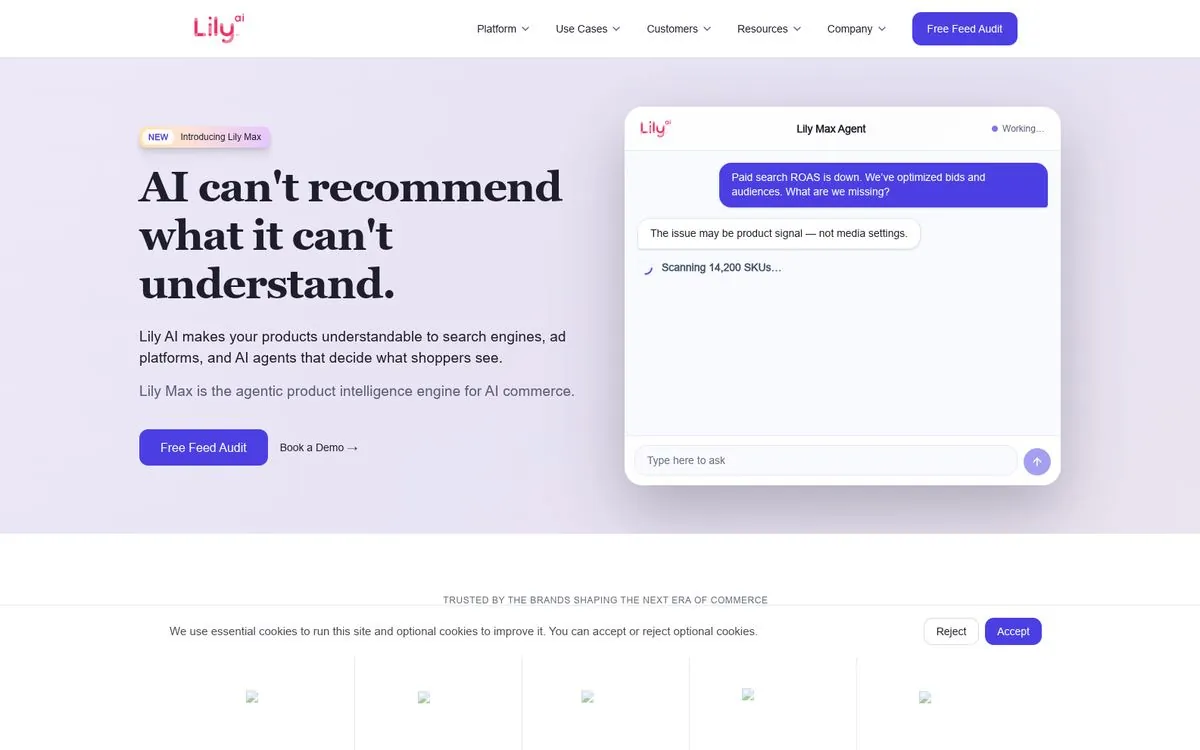
Lily AI enriches product data, including attributes, titles, copy and schema, so Google, Meta, onsite search and AI shopping agents can find and recommend products. Its Lily Max engine scores catalogue gaps, enriches and republishes the data and tests the change, and Lily says "nothing goes live without your sign-off". Marks & Spencer began using it in 2026, and Coach, J.Crew and HOKA appear on its homepage.
HQ: Mountain View, California · Funding: $20M Series B-1 in March 2024, taking the total to $62M (GlobeNewswire via Yahoo Finance) · Pricing: custom, scoped by catalogue size and markets, with a free feed audit
Best for: brands with thousands of styles whose product data was written for internal systems rather than shoppers.
Watch for: ask for the holdout design behind any lift figure. Lily says it cannot guarantee placement in AI answers. It is a data layer, not planning or design.
Sources: lily.ai, Lily Max, pricing, Retail Gazette.
13. Vue.ai: retail AI from Chennai, now inside a fintech group

Vue.ai was built by Mad Street Den, which M2P Fintech acquired in June 2025. Its homepage now sells an enterprise AI orchestration platform for banking, insurance, logistics, healthcare and retail. The retail tools are still on sale: automated product tagging, on-model imagery generated from mannequin or ghost shots, a virtual dressing room that shows products on models similar to the shopper, and recommendations. Diesel has used its tagging since 2020.
Offices: Redwood City, Chennai and Dubai (about page) · Founded: 2013, as Mad Street Den · Funding: about $50M raised before the acquisition (Inc42) · Pricing: on request · India: Chennai office; owner based in Chennai
Best for: fashion e-commerce teams that need tagging and on-model imagery at scale.
Watch for: the company's focus has moved to a general enterprise platform under a fintech owner, so confirm the fashion roadmap, support and recent fashion references.
Sources: vue.ai, M2P Fintech, Inc42.
Product photos and content
14. Botika: on-model photos from product shots
Botika turns flat-lay, hanger or ghost-mannequin photos into on-model images and short videos with AI-generated models, in bulk, with no prompting. Brands choose from 150+ AI models by body type, skin tone and market, or have a custom model made; prints, logos and textures are preserved, and retouch rounds by Botika's staff come with higher plans. Jordache, Heliot Emil, Nil + Mon and BLVCK are quoted on its pricing page.
HQ: Tel Aviv · Funding: $8M seed, January 2025 (PRWeb) · Pricing: published: Pro $55 a month ($46 billed yearly), Enterprise custom, free trial
Best for: fashion brands that want on-model and editorial images from the product photos they already have.
Watch for: resolution, retouch rounds and model access vary by plan. Its cost-saving figures are its own.
Sources: botika.com, pricing, case studies.
15. Claid.ai: product photo automation through an API
Claid turns flat-lay or ghost-mannequin shots into on-model images up to 4K, swaps models and faces to localise catalogue images while keeping the garment, offers 100+ AI models from petite to plus-size, makes five- or ten-second videos from stills, and handles upscaling, background removal and resizing, through a web app and an API. Fashion marketplace Kasta is a named case study, and it also runs a done-for-you service with its own engineers.
Company: made by Let's Enhance; Claid launched in 2021 · Funding: $3M seed, October 2021 (Claid) · Pricing: web plans with a free trial, pay-as-you-go API credits (two credits per AI fashion image), Business custom · India: Indian quick-commerce company Zepto is a customer, for image enhancement rather than fashion
Best for: marketplaces and retailers that need fashion images processed at high volume through an API.
Watch for: it serves many industries, so compare its fashion depth with fashion-only tools. Web-plan and API credits are bought separately.
Sources: Claid fashion, fashion automation, customers.
16. FlixStock: one product input, every channel's images
FlixStock turns one product input, such as an image, a sample photo or a tech pack, into on-model, ghost-mannequin, packshot, detail and video assets for product pages, social, ads, email and marketplaces. Its MetaModels line puts garments on AI models, and FlixStock says every asset passes combined human and AI quality control.
Founded: 2014 in Singapore, per its about page · Funding: $2.5M led by Wavemaker Partners, 2020, when it was reported as based in Gurugram (Inc42) · Pricing: on request · India: earlier Gurugram base; current India operations not stated on its site
Best for: brands that want a managed service to produce full sets of channel images from one input.
Watch for: its site lists a Polish company, Flixstudio sp. z o.o. in Wrocław, so confirm the contracting company and where support sits. It names no customers publicly.
Sources: flixstock.com, about, MetaModels, Inc42.
Virtual try-on and AR
17. Perfect Corp: try-on APIs from beauty to fashion and jewellery
Perfect Corp, maker of YouCam, sells AI and AR try-on through APIs and plug-ins: clothes and fabric, bags, shoes, hats, scarves, jewellery and watches, 3D eyewear and make-up, plus AI image and video tools. In January 2026 it added fashion APIs with built-in MCP support. Its +PLUS MIRROR uses the fashion try-on API in store, and Indian jeweller QWEEN added 3D try-on in 2026. It bought Wannaby from Farfetch in early 2025.
HQ: New Taipei City · Founded: 2015 · Ownership: listed on the NYSE until 23 October 2026, now private under ProjectNY, controlled by founder Alice Chang (FashionUnited) · Pricing: pay-per-use API with free credits to test (AI API), enterprise on request · India: customer QWEEN
Best for: brands that want head-to-toe try-on, from clothes to jewellery, through one API vendor.
Watch for: it has just gone private, so ask about roadmap and support. Its roots are in beauty; test clothing try-on against fashion specialists. Its YouCam AI Agent is a beauty assistant, not an agent that acts on your behalf.
Sources: perfectcorp.com, fashion API release, Retail Dive on the go-private deal.
18. DRESSX: AI try-on and imagery for luxury e-commerce

DRESSX moved from digital fashion into AI try-on and imagery: try-on on the shopper's own photo, video try-on, an AI Studio that turns flat lays into campaign images, mix and match, and a mirror for events. According to DRESSX, its try-on runs on the Victoria Beckham website. Its consumer DRESSX Agent (September 2025) finds and styles pieces from partners including Farfetch, Mytheresa and SSENSE, and in 2026 it ran live try-on events with Depop.
HQ: Los Angeles · Founded: 2020 · Funding: $15M, 2023 (Wikipedia) · Pricing: on request
Best for: luxury and premium e-commerce that wants try-on and AI campaign images from one vendor.
Watch for: its uplift figures are its own. The company has changed direction more than once, from digital fashion to AI, so confirm the roadmap. Size recommendation is listed on its site without detail.
Sources: dressx.com, DRESSX Agent release, Retail Technology Innovation Hub.
19. Veesual: products on models who look like the shopper
Veesual lets shoppers switch the model on a product page to one who looks like them, builds complete looks and mix-and-match outfits from a 2D image-generation engine, and now animates product images into short videos with VidCap, which leads its homepage. Eileen Fisher, Adore Me and Claudie Pierlot appear on its site, and La Redoute was reported as a customer in 2024.
HQ: Paris · Founded: 2020 · Funding: $7.5M seed led by AXA Venture Partners and Techstars, April 2024 (FashionUnited) · Pricing: VidCap credit packs from €40 to €875; try-on on request
Best for: apparel sites that want more model diversity and outfit styling without new shoots.
Watch for: the homepage now leads with video, so confirm continued investment in try-on. It is a small team; check service levels.
Sources: Veesual try-on, veesual.ai, FashionUnited.
20. mirrAR: jewellery try-on, CRM and voice agents for Indian jewellers
mirrAR puts jewellery, watches, eyewear and handbags on shoppers through web AR, apps, in-store screens and social filters, and adds visual search by photo. It now sells an AI CRM for WhatsApp, SMS and email follow-ups and appointment booking, and AI voice agents that call shoppers in English, Hindi and regional languages. Tanishq, Kalyan, Malabar and Senco appear on its site, with a Tanishq quote that online returns fell by 20%.
HQ: Bengaluru, with a US office in New Jersey (about page) · Started: 2015 as StyleDotMe; mirrAR since 2018 · Funding: not public · Pricing: published: Startup from $149, Pro from $450 and Scale from $599 a month, plus a set-up fee · India: headquartered in India
Best for: jewellers, Indian chains in particular, that want try-on online and in store with WhatsApp and voice follow-up.
Watch for: ask for a live demo of the newer CRM, voice and AI Studio modules. Their pages do not describe a person approving automated calls or messages.
Sources: mirrar.com, pricing, about. See also Ateliq vs mirrAR.
21. ZERO10: AR mirrors for windows, pop-ups and launches

ZERO10 makes AR try-on for clothes, bags and, as its homepage announces, shoes: AR mirrors and storefronts for stores, a web widget, photo try-on and an iOS SDK, built on computer vision, physics simulation and its own 3D engine. UGG used its AR mirror at its New York flagship.
Founded: 2020 · Funding: about $7.3M in pre-seed and seed rounds (Silicon Canals) · Pricing: on request
Best for: launches, store windows and pop-ups where an AR moment is the point.
Watch for: its older domains are parked and we found no dated news from 2025 or 2026, so check the team, support and recent references. AR try-on needs 3D assets; ask the cost per piece.
Sources: zero10.ar, Retail Brew. See also Ateliq vs ZERO10 and DRESSX.
Fit and size
22. True Fit: size advice from purchase and return data, now with an agent
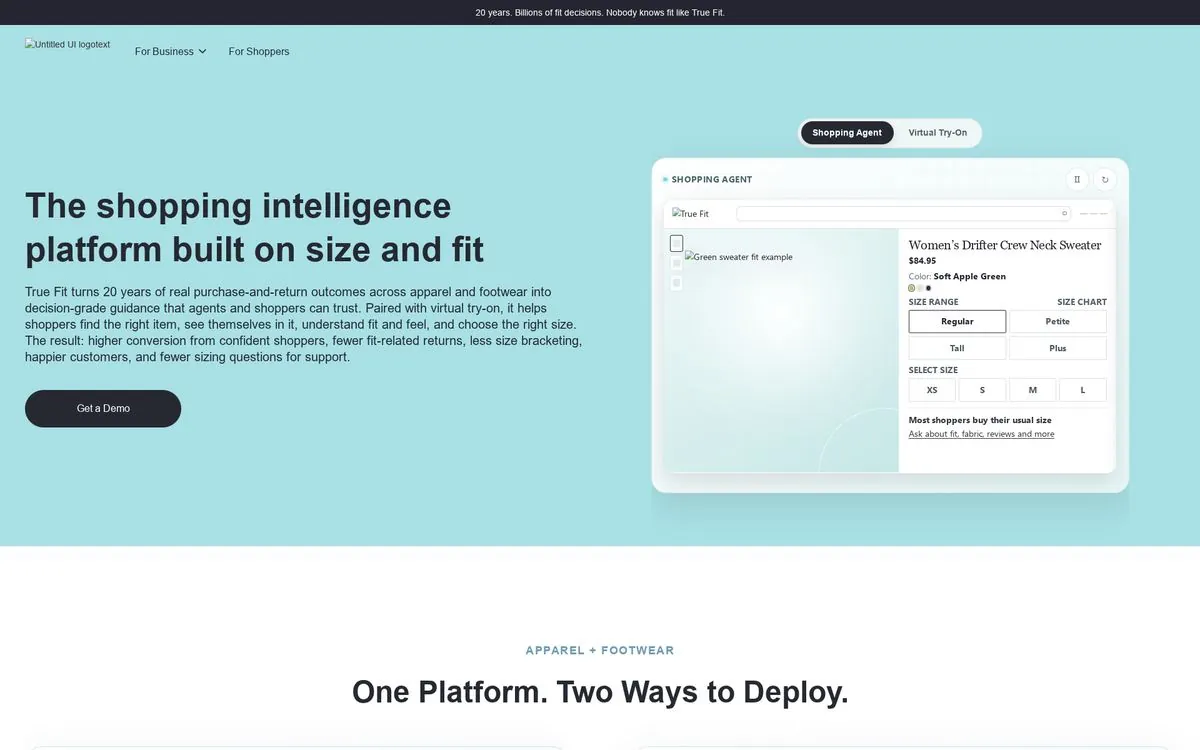
True Fit gives size and fit recommendations for apparel and footwear, built on about 20 years of purchase and return data, with size filtering on listing and search pages. In 2026 it launched an AI Shopping Agent that answers fit questions, added photo try-on, and offers fit data through MCP for other AI agents. Lands' End runs its Fit Intelligence.
HQ: Boston (about page) · Funding: $30M growth round led by Georgian, December 2021 (PR Newswire) · Pricing: on request
Best for: large apparel and footwear retailers that want size advice on their site and a route into AI shopping channels.
Watch for: user and market-share figures differ across its own pages, so ask for references. The agent mainly answers fit questions; its pages do not describe it taking actions.
Sources: truefit.com, agent launch, Reporting Center.
23. Fit Analytics: Fit Finder, independent again

Fit Analytics, maker of the Fit Finder size advisor, is independent again. Snap bought it in 2021 and sold the pre-acquisition IP back to its founder from January 2024 (Yahoo). In June 2026 it launched an AI Shopping Assistant that reads size, style, budget and context to narrow choices, built on structured size and fit data rather than a language model alone.
HQ: Berlin, with a Chicago office (who we are) · Funding: not disclosed since 2024 · Pricing: on request
Best for: apparel and footwear sites in Europe and the US that want a specialist size advisor with a conversational layer.
Watch for: IP built while Snap owned it stayed with Snap, so ask what has been rebuilt since. Its uplift figures come from unnamed retailers.
Sources: fitanalytics.com, who we are, ITWeb.
24. Bold Metrics: body data without photos
Bold Metrics builds a body "digital twin" from a few shopper answers, with no photos or scanning, and uses it for Virtual Sizer, a Smart Size Chart on product pages, Virtual Tailor measurements for made-to-measure, and Apparel Insights from body, purchase and returns data for design and distribution. Its Agentic Sizing Protocol gives fit and size recommendations to AI shopping agents. New Balance, Charles Tyrwhitt, Canada Goose and Vuori are among the brands on its site.
HQ: San Francisco · Funding: $8M Series A led by Bessemer Venture Partners, May 2022 (PR Newswire) · Pricing: on request
Best for: apparel brands that want size advice and made-to-measure data without asking shoppers for photos.
Watch for: ask how recommendations are validated against your own size charts, and which AI shopping agents already use its protocol.
Sources: boldmetrics.com, Series A release.
25. 3DLOOK: body measurement from two phone photos
3DLOOK's Mobile Tailor measures bodies from two smartphone photos, producing more than 80 measurements and a 3D model, for made-to-measure, uniforms and on-demand manufacturing. Shoppers can be scanned from a link, a web widget or an in-store QR code. Reformation, Oscar de la Renta and Lanieri appear on that page. Its homepage now leads with FitXpress, a health and fitness product.
Founded: 2016 (about page) · Pricing: published: Mobile Tailor Basic $499 a month (100 scans), Premium $999 (500 scans), Enterprise custom
Best for: tailoring, made-to-measure and uniform programmes that need remote measurements.
Watch for: its e-commerce size and try-on product no longer appears on its site, and its lead focus is now health, so ask how committed it is to apparel. Accuracy figures are its own.
Sources: Mobile Tailor, pricing, about.
Clienteling and the store
26. Tulip: clienteling for store associates, now with Salesfloor
Tulip is a clienteling and store app for associates: client profiles, outreach, appointments, mobile checkout, endless aisle, pay by link and a unified inbox for WhatsApp, SMS and email. Tulip AI drafts messages, summarises profiles and segments clients, with a choice of human approval at every step or more automated outreach; in August 2026 it added next-best actions. It merged with Salesfloor in March 2026. Versace, Coach, Pandora and Mulberry are among the customers it names.
HQ: Toronto · Founded: 2013 · Funding: $40M Series B led by Kleiner Perkins, 2017 (Tulip) · Pricing: on request
Best for: luxury and premium houses where much of the business comes from clients who know an advisor by name.
Watch for: two platforms are being brought together, so ask which one you would run on and how migration works. Check how client data is consented and kept across countries.
Sources: tulip.com, merger, Tulip AI. See also Ateliq vs Tulip.
27. Vêtir: an AI stylist and clienteling CRM for luxury brands
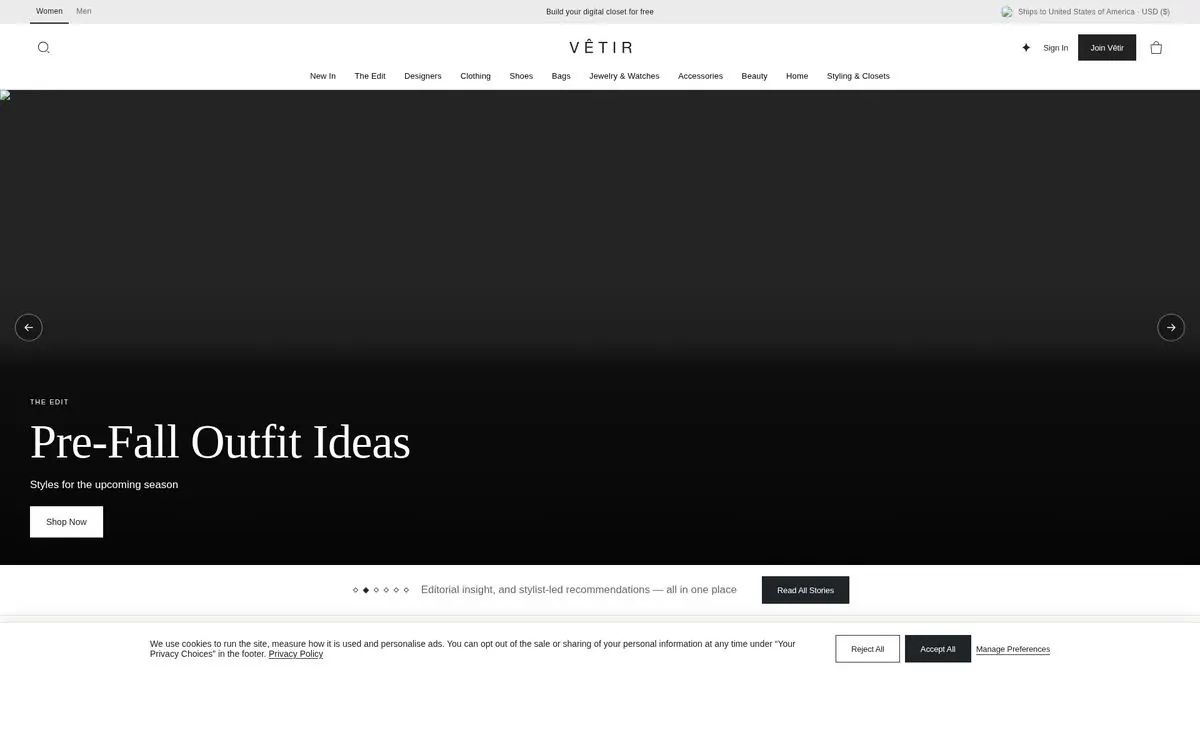
Vêtir began as a luxury wardrobe and AI stylist app, and in November 2026 launched Vêtir Enterprise for brands: an AI stylist by text, voice or photo, try-on on the shopper's own avatar, Style ID size translation across brands, agentic checkout that confirms size, delivery and payment in the chat and places the order, trend reports from styling conversations, and a clienteling CRM for stylists and leadership.
Founder: Kate Davidson Hudson · Funding: $5.5M first close of a Series A, May 2026 (FashionUnited) · Pricing: on request
Best for: luxury brands that want to pilot an AI stylist with try-on, size translation and clienteling on their own site.
Watch for: the enterprise product is new and no brand customers are named yet; brand names on its enterprise page are demonstrations. Its conversion and order-value figures are its own. Note the address: vetir.com is not its site.
Sources: Vêtir Enterprise, Just Style, Glossy, FashionUnited.
How to choose for 2027
Most brands will use three or four of these, one for each part of the business. These questions narrow the list:
- Where do you lose the most money? Markdowns and stock in the wrong store point to planning (Increff, Nextail, Stylumia). Returns point to fit (True Fit, Fit Analytics, Bold Metrics). Slow product pages point to content and data (Botika, Claid, FlixStock, Lily AI). Quiet stores point to the shop floor and clienteling (Ateliq, Tulip, mirrAR).
- What may the AI do alone? Agree in writing which actions need a person: prices, orders, stock moves, messages to clients and anything published. Ask each vendor to show where the approval happens, not only that it exists.
- Who will you contract with next year? Eight of the 26 changed owner, name or stock-market listing between 2024 and 2026. Ask about the roadmap, the contracting company and data portability.
- Whose numbers are they? Nearly every lift figure here comes from the vendor. Ask for a test against a control group or holdout; our guide on measuring an in-store AI pilot sets out a method.
- What happens to your data and designs? Check whether your images and archive train shared models, who owns the output, and where shopper data is processed. Cameras in stores bring extra rules; see privacy by design for in-store AI.
- Does it work in your markets? If you sell in India, Increff, Stylumia, mirrAR and Vue.ai are based there, WGSN sells Fashion Buying there, and Ateliq runs there today.
Sources
Each entry above lists its own sources. Sources for the method and for the companies we left out:
- Zyler: anthropics.com (where zyler.com now redirects) and Bridely closure notice; history in Textile World (2024)
- Syte: Syte by Nayax on AWS Marketplace, FF News on Nayax's product discovery (May 2026), North Base Media
- Lalaland.ai: FashionUnited on the Browzwear acquisition (July 2025)
- Ownership changes: Perfect Corp, Tulip and Salesfloor, M2P Fintech and Vue.ai, Heuritech and Luxurynsight, Trendalytics and Verishop, WGSN and Apax, Cala and Mercer, Fit Analytics and Snap
- Screenshots: Oxylabs Web Scraper API documentation
Questions people ask
What are the top fashion AI companies to engage in 2027?
Our list of 27 covers Nagent AI (Ateliq) for the store; Raspberry AI, Centric Software, Mercer and The New Black for design; WGSN, Heuritech, Stylumia and Trendalytics for trends; Increff and Nextail for planning; Lily AI and Vue.ai for product data and search; Botika, Claid.ai and FlixStock for product photos; Perfect Corp, DRESSX, Veesual, mirrAR and ZERO10 for try-on; True Fit, Fit Analytics, Bold Metrics and 3DLOOK for fit; and Tulip and Vêtir for clienteling. Nagent publishes the list.
Which fashion AI companies are based in India?
Increff, Stylumia and mirrAR are headquartered in Bengaluru, and Vue.ai has a Chennai office under its Chennai-based owner, M2P Fintech. WGSN sells its Fashion Buying platform in India, Perfect Corp counts the Indian jeweller QWEEN as a customer, and Ateliq runs in India and the United States.
Which fashion AI companies offer agents that act, not just answer?
Raspberry AI's agentic platform carries a brief from moodboard to product-page assets, Centric Software's agents build bills of materials, Lily AI's Lily Max republishes product data after a person signs off, Vêtir's agentic checkout places orders in a chat, mirrAR's voice agents call shoppers and book appointments, and Ateliq's twelve agents draft work that a person approves. Ask each vendor which actions need a person's approval.
Which fashion AI companies changed owner or name recently?
Perfect Corp went private in October 2026, Tulip merged with Salesfloor in March 2026, M2P Fintech acquired Vue.ai's maker Mad Street Den in 2025, Heuritech joined Luxurynsight in 2024, Verishop acquired Trendalytics in 2024, Apax funds bought WGSN in 2024, Fit Analytics bought its IP back from Snap in 2024, and Cala now trades as Mercer. Syte is now sold as Syte by Nayax, and Zyler is no longer sold.
What is the difference between virtual try-on and fit and size tools?
Virtual try-on shows how a piece looks on a shopper or a model, through AR or a generated image. Fit and size tools, such as True Fit, Fit Analytics, Bold Metrics and 3DLOOK, recommend which size to buy from purchase and return data, shopper answers or body measurements. Looking right and fitting right are different questions, and many brands use one of each.
How should a fashion brand choose AI vendors for 2027?
Start with where you lose the most money, such as markdowns, returns, slow product pages or quiet stores. Then agree which actions the AI may take alone, confirm who you will contract with after any merger, test the vendor's results against a control group, and check whether your images and data train shared models.
Does Ateliq replace the other companies on this list?
No. Ateliq covers the store: an AI stylist with live try-on on a mirror and a counter screen, answers from the store's own stock and prices, and twelve agents whose work a person approves. It works alongside planning, PLM, e-commerce try-on and clienteling tools, and does not write back to a POS or ERP.