Ateliq vs mirrAR for the jewellery counter
Ateliq and mirrAR compared for fine jewellery stores: AR try-on reach versus a stylist with metal-rate pricing, sizes, hand-off to sale and unmet-demand data.
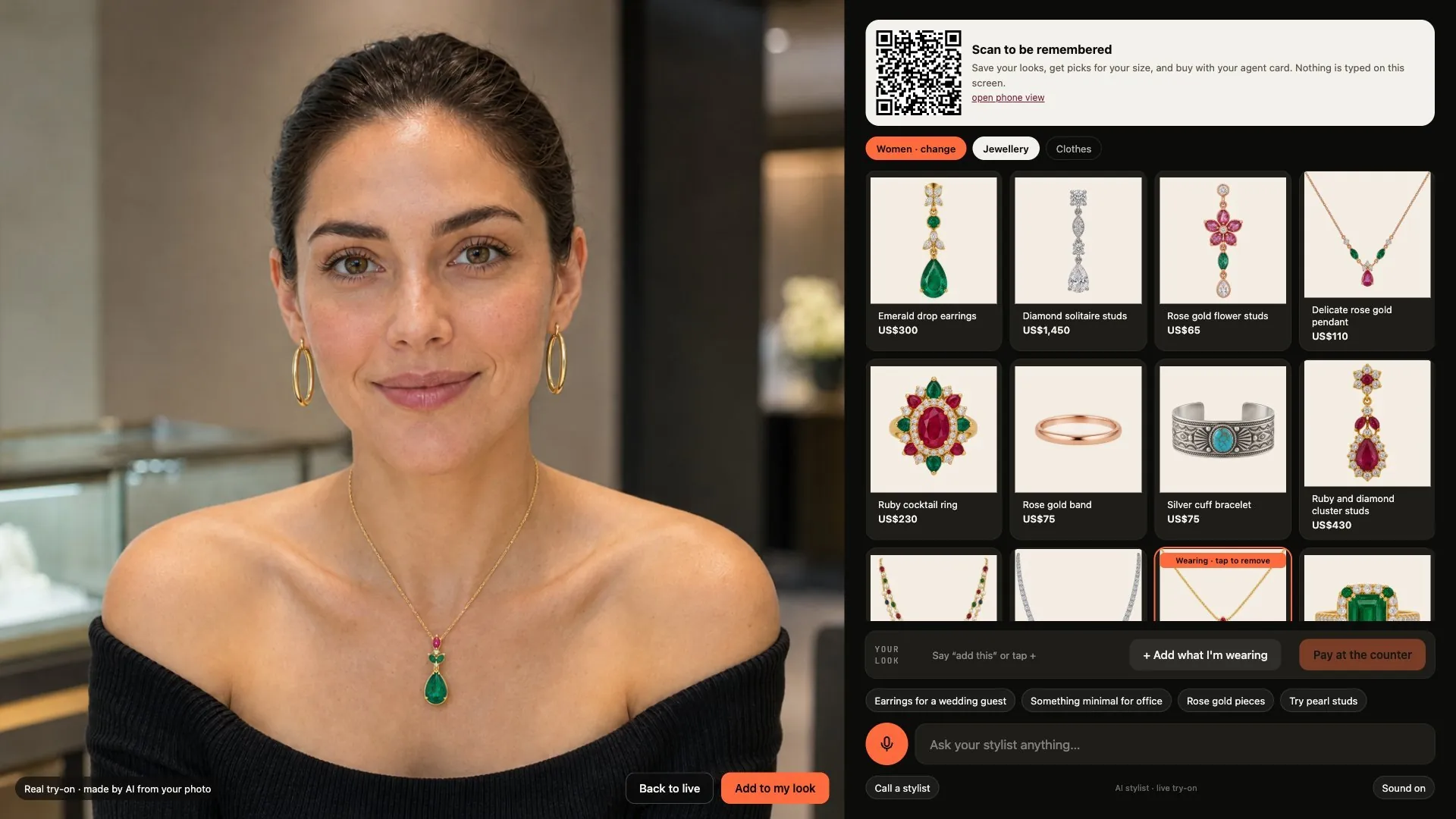
For trying jewellery on through a camera across a brand's website, app, social channels and stores, mirrAR is the established Indian choice, with Tanishq, Kalyan and Senco among the names on its site. For the job at the counter itself, Ateliq does more: a stylist that answers from the store's own stock and metal-rate prices, sizes the shopper confirms, a hand-off from the screen to the sale, and a report of what shoppers asked for that the store doesn't carry.
Ateliq is our product, so read this with that in mind. We describe mirrAR only from its own website and press coverage, as of November 2026, and link each claim. Where we could not find something, we say we found no public evidence of it. That is not the same as saying mirrAR cannot do it.
What job are we comparing?
The jewellery counter at a premium or fine jewellery chain. A family wants to see more than the case can safely open. One advisor is serving three groups. The gold rate moved this morning. A bride needs a full set, a groom's mother wants bangles in her size, and someone asks for a design the store doesn't hold. The question is what happens on the counter screen between the first try-on and the sale, and what head office learns afterwards. Try-on is the start of that job, not the whole of it.
What is mirrAR?
mirrAR is an Indian augmented reality company. Its about page says it began as StyleDotMe, a fashion app launched in Delhi, pivoted to mirrAR in 2018 and now works with "50+ enterprise clients". Its home page shows logos including Tanishq, Kalyan, Senco Gold & Diamonds, Malabar, Forevermark, Titan and Little Switzerland, and sells try-on in four channels: WebAR on a brand's website, a mobile SDK for its app, SocialAR filters and an in-store option.
In store, mirrAR says its software "will be integrated on iPads placed inside your store, which can be connected to larger screens", with a digital vault to "stock & manage infinite digital jewellery pieces" (mirrAR In-Store). Its jewellery page describes try-ons on centralised inventory, so a store can show designs it does not stock, and says pricing "is based on the volume of try-ons & is billed annually".
mirrAR has also added AI products around try-on. Its AI-powered CRM sends follow-ups by WhatsApp, SMS, email and AI voice calls, triggered by occasions, cart abandonment and appointments, and says it is built for independent and small jewellery businesses. A September 2025 post describes mirrAR Voice AI answering calls in Hindi, English, Tamil, Telugu and Bengali, quoting live 22K and 24K gold rates and making charges, and booking bridal appointments.
What is Ateliq?
Ateliq is the AI stylist and sales system for fashion and jewellery stores, built on Nagent's agent platform. It is AI-native: a stylist and twelve agents were the design from the first day, and try-on is one thing the stylist does. It runs on two screens with the same stylist, a landscape counter screen for jewellery and a full-length mirror for the shop floor. Shoppers need no app and no sign-in. Ateliq runs today in India and the United States, and is delivered end to end: we supply and set up the screens, onboard the catalogue, train staff and support the stores.
How do they compare at the counter?
| Capability | Ateliq | mirrAR |
|---|---|---|
| Live jewellery try-on | Eleven kinds, from jhumkas and nose pins to rings, bangles and watches | Necklaces, earrings, rings, bracelets and more |
| Where it runs | In store: counter screen and mirror | Website, app SDK, social filters and in store |
| Stylist on the screen | Answers from this store's stock, sizes, prices and offers | No public evidence found of one on the in-store screen |
| Metal-rate price | Built from weight, rate, purity, making, stones and GST, shown in parts | Voice AI quotes live gold rates on calls; no public evidence found of an on-screen build-up |
| Stale rates | A rate older than 48 hours never prices a piece | No public evidence found |
| Hallmark facts | Karat, net and gross weight, hallmark, HUID check note | No public evidence found on current pages |
| Ring and bangle sizes | Shopper taps their size; store sizer confirms | No public evidence found |
| Stacks and bridal sets | Four rings, six wrist pieces; curated sets in one tap | No public evidence found |
| Screen to sale | Hand-off code: hold, pay link, online cart or counter | No public evidence found |
| Follow-ups | Opt-in by code; email or WhatsApp; two a week at most | WhatsApp, SMS, email and voice calls; opt-in rules not described |
| Appointments | Bridal and high-jewellery, booked from the phone | Through its CRM and Voice AI |
| Unmet demand | "Asked for, not carried", by phrase and store | No public evidence found |
| Fashion | Same system: full-length mirror, ten kinds of garment | Site promotes AI clothing try-on |
| Named customers | None yet; design-partner pre-orders open | Tanishq, Kalyan, Senco and others |
Where is mirrAR strong?
- Named customers. mirrAR shows some of the biggest names in Indian jewellery. Its site carries a quote attributed to Tanishq that "the returns of our online orders have reduced by 20% in the past year", and its jewellery page quotes Senco's MD and CEO saying the tool was integrated in six offline stores and used by more than a lakh customers. In March 2026 Jos Alukkas launched mirrAR try-on on its website, as Indiantelevision reported. These are vendor-hosted figures, not audited results, but the relationships are real. Ateliq has no named customers yet.
- AR maturity. Since its 2018 pivot, mirrAR has spent eight years on jewellery AR, and it shows in the categories and channels it supports.
- One try-on everywhere. The same try-on on the website, in the app, in social filters and in store. Ateliq is in-store only, apart from the shopper's phone acting as a remote and style profile.
- Endless aisle. A digital vault lets a small store show designs it does not hold.
- Regional languages by phone. mirrAR Voice AI speaks five Indian languages on calls. Ateliq's voice commands are in English, with US and Indian English voices, and the stylist writes back in the shopper's language.
Where does Ateliq go further at the counter?
A stylist that knows this store
Shoppers ask out loud or tap. The stylist answers from this store's catalogue, sizes, prices and offers, compares two pieces side by side, completes a look with at most two add-ons and always offers a "just this" exit. When the shopper wants to see a piece properly, Ateliq makes a photo of them wearing the exact pieces, from the brand's own product photos, sent to their phone and deleted after 30 minutes. We explain why that photo matters in virtual try-on for fine jewellery.
Prices that hold up to the day's rate
On the counter screen, a gold or silver piece is priced as net weight times today's rate per gram times purity, plus making charges (a percentage, per gram or flat), plus stones, plus 3% GST in India, and shown with its parts. Head office enters the gold, silver and platinum rate for each market, or confirms a live rate Ateliq proposes every six hours. A rate that jumps more than 10% asks for a second look. A rate older than 48 hours never prices a piece: it leaves the screen or shows "Price at the counter", and the stylist won't quote it.
Facts a careful buyer checks
Each piece shows metal, purity, net and gross weight, stones and hallmark. Karat is worked out from the purity, never typed in. BIS pieces carry a note on how to check the HUID in BIS CARE.
Sizes, stacks and sets
The shopper taps the ring or bangle size they wear, in the market's own sizes, and sees pieces in that size. If they are unsure, an advisor brings the store's ring sizer and sizing bangles. The camera never guesses a size. Shoppers can wear up to four rings and six wrist pieces together, and head office curates sets of two to eight pieces that a bride can try in one tap.
From the screen to the sale
Buy turns the look into a hand-off code that carries the visit and the associate who helped. The shopper holds the pieces in store, pays with a Razorpay or Stripe link on their phone, finishes in the brand's online shop, or pays at the counter. The screens never take payment. One tap calls the floor team. With orders or a payment provider connected, each hand-off becomes kept, partly returned or returned.
Follow-ups and appointments that respect the shopper
Follow-ups go only to shoppers who opt in and confirm with a six-digit code, by email or through the brand's WhatsApp Business account. Programmes start switched off. Messages use templates a person approved, at most two a week, never between 9pm and 9am, with stock checked first and no prices or urgency, and each carries a one-click unsubscribe. Bridal and high-jewellery appointments are booked from the shopper's phone within the store's hours and capacity. Our guide to AI for bridal and engagement ring appointments covers that visit in more depth.
Twelve agents, and what the counter learns
Behind the glass, twelve agents (retail lead, trend scout, retail analyst, merchandise analyst, fashion strategist, designer, marketer, clienteling, cataloguer, photographer, market watch and FabFit charts) draft trend boards, design concepts, product shoots, posts, store reports and follow-up queues. None of them can show anything to a shopper or post in public; a person approves each one. Every Monday the analyst reports what was tried, asked for, bought, kept and returned. "Asked for, not carried" groups requests the store doesn't stock by phrase and store, ready for buying.
Privacy by design
A start screen asks for camera consent and says the stylist is an AI. Hands are treated as biometric data. Tracking stays on the screen and nothing is recorded. Ateliq never infers race, ethnicity, body shape or weight. Nagent is ISO/IEC 27001:2022 certified and has a SOC 2 Type II report.
One system for the counter and the mirror
A chain that also sells sarees, lehengas, dresses or jackets runs the same stylist on a full-length mirror, with ten kinds of garment. Catalogue and stock come from Shopify, SAP S/4HANA, Unicommerce, a REST API, CSV or other connectors, and Ateliq never writes back to your POS or ERP.
Which should you choose?
If your priority is AR try-on on your website, app and social channels, with a vendor that already serves India's largest jewellers, mirrAR is a strong and proven choice.
If your priority is the counter, Ateliq is the better fit. It is the stylist, the price desk and the sales assistant in one: it answers from your stock, prices from a confirmed metal rate and refuses a stale one, shows the hallmark facts buyers check, handles sizes, stacks and bridal sets, hands each sale to your team with the associate attached, follows up only with consent, and tells head office what shoppers wanted and couldn't find. The two can sit side by side: mirrAR online, Ateliq in the store.
See it on our fictional demo store's catalogue at the live demo, then pre-order as a design partner.
Questions people ask
What is the difference between Ateliq and mirrAR?
mirrAR is an AR try-on platform used across jewellers' websites, apps, social filters and stores, with Tanishq, Kalyan and Senco on its site. Ateliq is an in-store AI stylist and sales system: it tries pieces on, answers from the store's own stock and metal-rate prices, hands the sale to staff and reports unmet demand.
How does Ateliq price gold jewellery on the counter screen?
From the piece's net weight, purity and today's metal rate, plus making charges, stones and 3% GST in India, shown with its parts. Head office sets or confirms the rate, and a rate older than 48 hours never prices a piece.
Can a jeweller use mirrAR and Ateliq together?
Yes. Ateliq runs only in the store, on a counter screen and a mirror, so a chain can keep AR try-on on its website and app and use Ateliq at the counter.