Top 10 agentic AI use cases for jewellery retail in 2026
Ten ways AI agents help jewellery stores, from metal-rate pricing and BIS hallmark facts to counter try-on, sizing, bridal appointments, old-gold estimates and follow-ups.
The ten agentic AI use cases that matter most to jewellery retailers in 2026 are: pricing from today's metal rate, hallmark and disclosure facts at the counter, try-on at the counter with sets and stacks, ring and bangle sizing, bridal and high-jewellery appointments, old-gold exchange estimates, festive and wedding-season campaigns, stock visibility across stores, follow-ups for life's occasions, and counter analytics. In each one an agent reads, drafts or acts within limits the jeweller sets, and a person signs off on rates, prices and anything a customer will see.
This guide is for owners, retail heads and store managers at jewellery chains and family jewellers, from a 22K gold house in Chennai or Thrissur to a diamond jeweller in Mumbai, Dubai or New York. For every use case we set out the job today, what an agent does, where a person approves, the data it needs, how to measure it and the risks. Where Ateliq, our own product, does the job today we say so. Where it does not, we describe where the market is heading.
What does "agentic" mean at a jewellery counter?
An AI agent reads, decides and acts within limits a person sets. A chatbot can tell a customer what 22K means. An agent can price a necklace from its net weight and today's confirmed rate, show the breakdown, notice that the rate is two days old and stop quoting, and call an advisor when the customer is ready to see the piece.
Jewellery makes the limits sharper than in any other part of fashion. Prices move with the metal every day, every piece is high value, and trust rests on purity, weight and honest disclosure. So the rule throughout this guide is simple: agents prepare, calculate and remind; people confirm the rate, handle the piece and close the sale.
The ten at a glance
| Use case | What the agent does | Who approves | In Ateliq today? |
|---|---|---|---|
| 1. Metal-rate pricing | Prices each piece from weight, purity, rate, making and stones | Head office confirms the rate | Yes |
| 2. Hallmark and disclosure facts | Shows purity, weights, hallmark and how to check it | Head office keeps the records | Partly |
| 3. Try-on, sets and stacks | Live try-on and photo-real try-on; sets in one tap | Head office curates sets | Yes |
| 4. Ring and bangle sizing | Shows pieces in the size the customer wears | The store's sizer has the final word | Yes |
| 5. Bridal and high-jewellery appointments | Books visits; prepares the advisor | The advisor | Partly |
| 6. Old-gold exchange estimates | Drafts an estimate from tested purity and weight | The counter, after testing | Market |
| 7. Festive and wedding-season campaigns | Drafts posts, shoots and calendars tied to live offers | Marketing | Yes |
| 8. Stock visibility across stores | Finds the piece in another store; proposes transfers | Store and inventory managers | Market |
| 9. Follow-ups for life's occasions | Queues messages for opted-in customers | Approved templates | Yes |
| 10. Counter analytics | Reports tried, bought, attach and step-up by store | Read by managers | Yes |
1. Pricing from today's metal rate
The job today. Gold jewellery in India is priced from net weight, purity and the day's rate, plus making charges, stones and GST, which is 3% of the whole transaction value, whether or not making charges are shown separately. Rates move every day: in India the IBJA publishes opening and closing reference rates each day for purities from 999 to 585, and in London the LBMA Gold Price is set in auctions at 10:30 and 15:00. Staff update rates by hand, tags go stale, and a customer who sees a different price at the next counter loses trust.
- What the agent does: proposes the day's rate for each market and metal from a source the jeweller chooses, prices every piece from its weight, purity, making charges and stones, shows the breakdown, and stops quoting when the rate is stale.
- Who approves: head office sets or confirms every rate. A big jump should ask for a second look.
- Data it needs: net and gross weight, purity, making charge rules (a percentage, per gram or flat), stone prices, and the tax rules for each market.
- How to measure it: price disputes at the counter, time spent updating rates, and pieces sold at a stale price (which should be zero).
- Risks and guardrails: a wrong rate is a wrong price on every piece at once. Keep a person on the rate, show its time, and refuse to price from an old one.
In Ateliq today. Each piece is priced as net weight × today's rate per gram × purity, plus making charges (a percentage, per gram or flat), plus stones, plus 3% GST in India, rounded and shown with its parts and the time of the rate. Head office enters the gold, silver and platinum rate for each market, or confirms a live rate Ateliq proposes every six hours. A rate that jumps more than 10% asks for a second look, and a rate older than 48 hours never prices a piece: the piece leaves the screen or shows "Price at the counter".
2. Hallmark, purity and disclosure facts at the counter
The job today. Customers ask what 916 means, whether a piece is hallmarked, and how to check. In India, BIS hallmarking of gold jewellery has been mandatory since June 2021 in the districts it covers (392, by BIS's latest count), each hallmarked piece carries a six-digit alphanumeric HUID, and a customer can check it with the "Verify HUID" feature of the BIS CARE app. HUID hallmarking for silver followed on a voluntary basis from 1 September 2025. In the US, the FTC's guidance on its Jewelry Guides says sellers of laboratory-created diamonds should tell consumers they are not mined, with a word such as "laboratory-grown" placed right before "diamond". Advisors know this; a new hire may not.
- What the agent does: shows each piece's metal, purity and karat, net and gross weight, stones and hallmark; explains in plain words how to check a HUID; and states clearly whether a stone is natural or laboratory-grown, from the jeweller's own records.
- Who approves: head office owns the product records; certificates stay the final word.
- Data it needs: hallmark and HUID per piece, stone details and grading reports, and the disclosure rules for each market.
- How to measure it: questions resolved without calling an advisor, and complaints about disclosure (which should fall).
- Risks and guardrails: an agent must never infer purity or a stone's origin from a photo. It repeats the record or says "ask the advisor".
Where Ateliq is today. "About this piece" shows metal, purity, karat worked out from the purity (916 is 22K), net and gross weight, stones and hallmark, and for BIS pieces it tells the shopper how to check the HUID in the BIS CARE app. Natural or lab-grown disclosure comes from the brand's own product data. Where the market is heading: agents that read certificates and grading reports directly and answer from them.
3. Try-on at the counter, with sets and stacks
The job today. Security guidance is to show one piece at a time: the American Gem Society tells staff never to have more than two pieces out of the showcase at once. A bride trying a full set, or a customer comparing ten pairs of jhumkas, takes an advisor's whole hour.
- What the agent does: lets the customer try pieces on screen, live, including whole sets and stacks, and on request makes a photo of her wearing the exact pieces, so the advisor brings out only the shortlist.
- Who approves: head office curates sets; the customer asks for each photo.
- Data it needs: good product photos, real sizes in millimetres for rings and bangles, and set definitions.
- How to measure it: pieces taken out of the case per sale, time per customer, and conversion of tried pieces.
- Risks and guardrails: on-screen try-on does not replace the weight and sparkle of the real piece. Use it to narrow the list, as we discussed in trying on fine jewellery without opening the case.
In Ateliq today. Face and hand tracking for earrings, necklaces, nose pins, rings, bangles, bracelets and watches; up to four rings and six wrist pieces worn together; head office curates sets of two to eight pieces, and a shopper tries a whole bridal set in one tap. A photo of the exact piece on her, made from the brand's product photo, goes to her phone and is deleted after 30 minutes.
4. Ring and bangle sizing
The job today. Sizes differ by market (Indian, US, UK and EU ring sizes; bangles in their own sizes), and a customer often does not know hers. Staff fetch the sizer, then look for the piece in that size.
- What the agent does: asks the size the customer wears, in her market's sizes, and shows only pieces available in that size; if she is unsure, it calls for the sizer.
- Who approves: the store's ring sizer and sizing bangles have the final word.
- Data it needs: stock by size, and whether each design can be resized.
- How to measure it: resizing requests after sale, and time from interest to the right size on the hand.
- Risks and guardrails: a camera guess at a ring size is a returned ring. Ask; do not guess.
In Ateliq today. The shopper taps the ring or bangle size she wears, in the market's own sizes, and sees the pieces in that size. Not sure? A stylist brings the store's ring sizer and sizing bangles. The camera never guesses a size.
5. Bridal and high-jewellery appointments
The job today. Bridal buying in India is a family event planned around the wedding date, and engagement-ring buying in the US still happens mostly in store. Appointments are booked by phone, and advisors often meet the family knowing little about what they want.
- What the agent does: books the visit within the store's hours and capacity, sends reminders, and prepares a one-page brief for the advisor from what the customer saved and said: budget, metal, style, the wedding date, pieces she tried.
- Who approves: the advisor runs the appointment; the customer chooses what to share.
- Data it needs: the store's calendar and capacity, saved looks, and consented notes.
- How to measure it: show rate, conversion per appointment and average order value.
- Risks and guardrails: budget and family details are sensitive. Keep only what the customer chose to share, and let the advisor confirm every technical answer.
Where Ateliq is today. Shoppers book bridal and high-jewellery appointments from their phone, within the store's hours and capacity; the team sees the day's list, which also appears in Google Calendar or Outlook through a private calendar link, and confirmations and 24-hour reminders are sent. Ateliq does not write an advisor brief today. Where the market is heading: preparation briefs built from saved looks, which we described in AI for bridal and engagement ring appointments.
6. Old-gold exchange estimates
The job today. In India, many purchases start with old gold: a customer brings pieces to exchange against new ones. The counter tests purity, weighs, deducts for stones and loss, and quotes, often while the customer waits and worries about fairness.
- What the agent does: once the counter has weighed and tested the old gold, drafts the estimate from the tested purity, net weight and the jeweller's published exchange rules, shows each step, and applies the value to the new piece the customer is choosing.
- Who approves: the counter tests and weighs every piece and approves every estimate.
- Data it needs: the test result and weights, today's confirmed rate, and the jeweller's written exchange and buyback policy.
- How to measure it: time per exchange, disputes, and exchanges that turn into a purchase.
- Risks and guardrails: an agent must never estimate purity from a photo or a description. It calculates from the tested figures only, and shows the customer the same breakdown the counter sees.
Where the market is heading. Ateliq does not handle old-gold exchange. We expect exchange calculators to become agents that sit beside the testing machine and the pricing engine, so the customer sees one honest breakdown from old piece to new.
7. Festive and wedding-season campaigns
The job today. Indian jewellery sells around Akshaya Tritiya, Dhanteras and Diwali, and through the wedding season; elsewhere around Valentine's Day, Mother's Day, Eid and the holidays. Each needs shoots, posts and a calendar, and gold-rate swings can make a planned price wrong by launch day.
- What the agent does: drafts product shoots with the jewellery on a model from the brand's own photos, a lookbook from best sellers, posts tied to offers that are running, and next week's calendar.
- Who approves: marketing approves every draft and does the posting.
- Data it needs: product photos, live offers with dates and stores, stock, and the brand's voice.
- How to measure it: hours per campaign, posts published from drafts and sales of featured pieces.
- Risks and guardrails: never quote a price in a post that the rate can change, and never change the piece itself in an AI image.
In Ateliq today. The photographer makes product shoots, including jewellery on a model, and short clips from the brand's own photos; the piece itself is never changed. Every Wednesday the marketer drafts a lookbook, up to three social posts tied to live offers and next week's content calendar. Head office runs initiatives such as a festive sale or a trunk show, with a banner on the screen and a brief for the stylist. Approving a post does not post it.
8. Stock visibility across stores
The job today. A customer wants the design in the window in 18K, or in a lighter weight. It might be in another branch, on memo with a supplier, or at the workshop. Staff phone around.
- What the agent does: finds the piece or its nearest match across stores and suppliers, offers to reserve it or bring it in, and proposes transfers where demand repeats.
- Who approves: store and inventory managers approve every reservation and transfer; high-value movements follow the jeweller's security process.
- Data it needs: stock by store with weights and variants, memo and consignment stock, and transfer rules.
- How to measure it: sales saved by transfer, days to fulfil, and stock-holding by store.
- Risks and guardrails: never reveal where high-value stock sits to anyone who does not need to know.
Where the market is heading. Ateliq does not move stock and does not write back to a POS or ERP. It does record what customers asked for that the store does not stock, grouped by phrase and store, to send to a planning system. Inventory agents that propose transfers are arriving from planning vendors.
9. Follow-ups for life's occasions
The job today. Anniversaries, birthdays and weddings drive jewellery buying, and the best advisors keep notebooks. When an advisor leaves, the notebook goes too.
- What the agent does: for customers who opted in, remembers sizes, occasions and pieces they loved, and queues a short message when a piece is back in her size or about a piece she tried, checking stock first.
- Who approves: the jeweller approves every template; the customer can stop at any time.
- Data it needs: consent, saved pieces and sizes, and live stock.
- How to measure it: opt-in rate, return visits and sales from follow-ups against customers not messaged.
- Risks and guardrails: no prices in messages (the rate moves), no pressure, quiet hours, and contact details kept away from the agent itself.
In Ateliq today. Ateliq remembers only shoppers who choose to be remembered, and confirm with a code: their sizes, occasions and what they loved. The clienteling agent queues follow-ups for them with up to three in-stock pieces each, and never sees a name, email or phone number. Messages go by email or WhatsApp from approved templates, at most two a week, never between 9pm and 9am, with no prices and no urgency.
10. Counter analytics
The job today. A jeweller knows what sold. It rarely knows which pieces were tried most and bought least, how often a customer added earrings to a necklace, or how often she stepped up to a heavier piece.
- What the agent does: drafts a weekly report per store: most tried and least bought, attach and step-up rates, time to decide, what customers asked for and could not find; and answers head office's questions in plain words.
- Who approves: nobody approves a report, but every number should trace back to its source.
- Data it needs: try-ons, sales, requests and door counts if you have them.
- How to measure it: decisions taken from the report: re-displays, re-orders, design briefs.
- Risks and guardrails: small numbers in fine jewellery. Read trends over weeks, not days.
In Ateliq today. The store view shows try-ons, purchases, jewellery attach rate, most tried and least bought, add-on and step-up rates, time to decide and returning shoppers. Every Monday the analyst drafts a report for each store and across all stores, and head office can ask its stores questions in plain words.
How to start in 90 days
Start with pricing and the counter, because they share data and protect trust, then add follow-ups once templates are approved.
- Days 1 to 30: get the records right. Check weight, purity, making charges, stones and hallmark for every piece you will show. Decide who confirms the rate and when. Record four to eight weeks of baseline at the pilot and a matched control store.
- Days 31 to 60: go live at one counter. Price from the confirmed rate, train advisors to use the screen to shortlist, and read the weekly report.
- Days 61 to 90: measure and decide. Compare conversion, pieces out of the case per sale and average order value with the control store. Fine jewellery has fewer, larger sales, so expect to need longer than a fashion pilot before the numbers settle.
See how to measure an in-store AI pilot for the method.
Take the playbook, or see it live
All 40 use cases from this series, across jewellery retail, jewellery design, fashion retail and fashion design, are in one free guide with a readiness checklist, a 90-day pilot plan and a vendor scorecard: The Agentic AI Playbook for Fashion and Jewellery. To see metal-rate pricing and counter try-on for yourself, open the live demo.
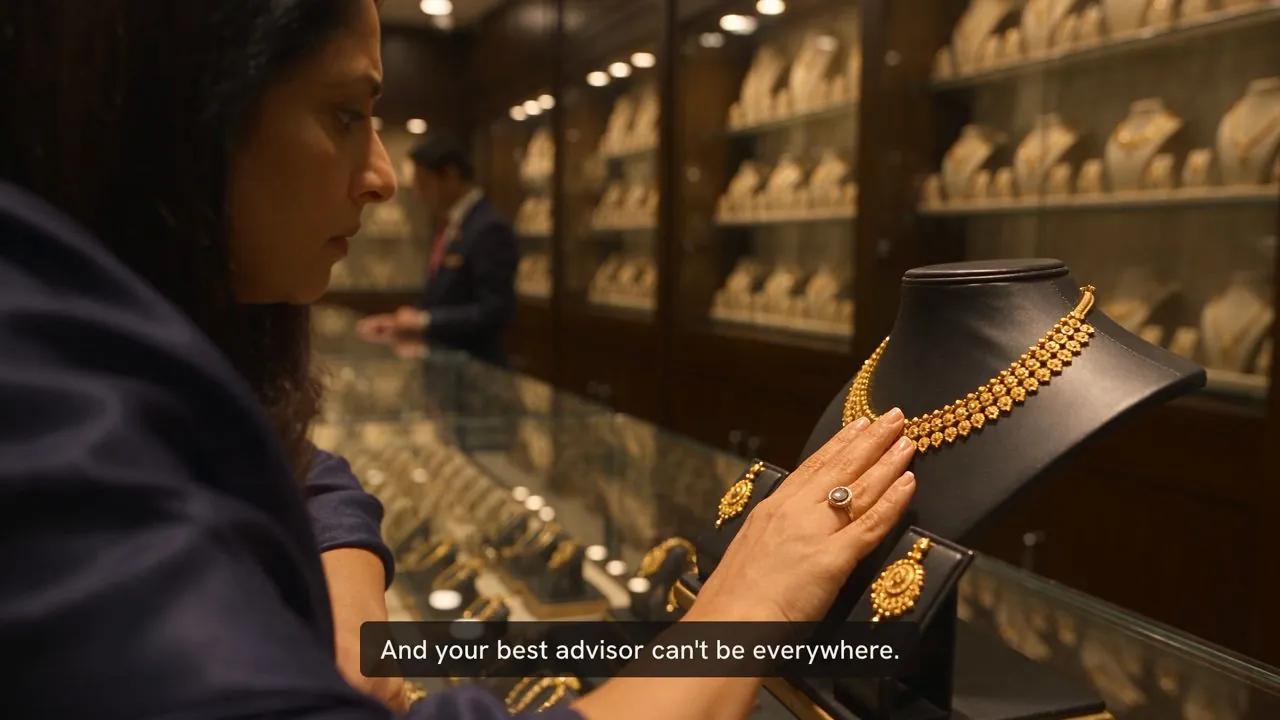
The image at the top of this article is a still from our demo film, made with AI. The store and the customer are fictional.
Sources
- Bureau of Indian Standards, brief on the hallmarking scheme
- Bureau of Indian Standards, consumer protection and BIS CARE
- GST sectoral series: gems and jewellery FAQ and PTI on the rate kept at 3% (September 2025)
- India Bullion and Jewellers Association rates
- LBMA precious metal prices
- US Federal Trade Commission, In the Loupe: advertising diamonds, gemstones and pearls
- American Gem Society / Jewelers Mutual: grab-and-run jewelry thefts
Questions people ask
What is agentic AI in jewellery retail?
AI agents that read, decide and act within limits the jeweller sets: pricing a piece from its weight and today's confirmed rate, showing hallmark facts, letting a customer try sets on screen, booking appointments or queuing follow-ups for customers who opted in. People confirm rates, handle the pieces and close the sale.
How can AI price gold jewellery from the daily rate?
From the piece's net weight, purity and today's rate, plus making charges and stones, plus tax. In India GST on gold jewellery is 3% of the whole transaction value. A person should confirm the rate, the time of the rate should be shown, and a stale rate should never price a piece.
How do customers check BIS hallmarking in India?
Each hallmarked gold piece carries a six-digit alphanumeric HUID, which a customer can check with the Verify HUID feature of the BIS CARE app. BIS hallmarking of gold jewellery has been mandatory since June 2021 in the districts it covers.
Does virtual try-on help jewellery counters?
Yes, for narrowing a long list. Customers try many pieces and whole sets on screen, and the advisor brings out only the shortlist, which suits security guidance to keep few pieces out of the case. Weight, sparkle and fit still need the real piece in the hand.
Can AI calculate old-gold exchange value?
It can draft the estimate, but only from figures the counter has measured: the tested purity and net weight, today's confirmed rate and the jeweller's written exchange policy. It should never estimate purity from a photo or a description.
Where should a jeweller start with AI agents?
With metal-rate pricing and the counter, because they share product data and protect trust. Check every piece's weights, purity, making charges and hallmark first, run one counter for 30 days, and measure against a matched control store for longer than a fashion pilot.