Top 10 agentic AI use cases for fashion design in 2026
Ten ways AI agents help fashion design teams, from trend briefs and four-view concepts to tech packs, sampling and designs from a shopper's cloth, with who approves each.
The ten agentic AI use cases that matter most to fashion design teams in 2026 are: trend scouting into a weekly brief, briefs from unmet demand, concepts in the brand's own hand, print and motif development, tech packs and spec sheets, testing concepts with shoppers before sampling, designs from a shopper's chosen cloth, fabric sourcing and product passports, range reviews, and originality checks. In each one an agent does the reading, drafting and checking, and a designer decides what goes forward.
This guide is for design directors, heads of product and the people who run sampling at fashion brands, from a handloom label working with weavers in Varanasi or Pochampally to a ready-to-wear brand shipping to Europe. For every use case we set out the job as it is done today, what an agent does, where a person approves, the data it needs, how to measure it and what can go wrong. Where Ateliq, our own product, does the job today we say so. Where it does not, we describe where the market is heading.
What does "agentic" mean in fashion design?
An AI agent reads, decides and acts within limits a person sets. A chatbot answers a question and waits. An agent is given a goal, such as "draft next week's design directions", and takes the steps itself: it reads the trend board and the sales report, picks out what matters, drafts the work and hands it to a person. It can run on a schedule, every Monday or every Tuesday, without being asked.
In design, the limits matter more than the cleverness. A good design agent never sends a sketch to a factory, never orders fabric and never shows a concept to the public on its own. It drafts and a designer approves. That is how every use case below is framed: the agent takes the hours of gathering and first drafts; people keep taste, judgement and sign-off.
The ten at a glance
| Use case | What the agent does | Who approves | In Ateliq today? |
|---|---|---|---|
| 1. Trend scouting into a weekly brief | Reads press, social and store signals; drafts a trend board and design directions | Design or merchandising lead | Yes |
| 2. Briefs from unmet demand | Groups what shoppers asked for and could not find; drafts a brief | Head of design | Yes |
| 3. Concepts in the brand's own hand | Draws concepts from a print, a sample or a trend, in four views | Designer | Yes |
| 4. Print, motif and colourway development | Builds options from an existing print or motif for a designer to edit | Print designer | Partly |
| 5. Tech packs and spec sheets | Drafts measurements, trims and construction notes from an approved design | Technical designer | Partly |
| 6. Testing concepts before sampling | Shows approved concepts to shoppers and counts tries and votes | Design and merchandising | Yes |
| 7. Designs from a shopper's chosen cloth | Designs dresses from the exact cloth, shows one on her, briefs the tailor | Store and head office | Yes |
| 8. Fabric sourcing and product passports | Matches fabric needs to suppliers; gathers fibre and origin records | Sourcing lead | Market |
| 9. Range reviews | Checks a planned range against sales, trends and gaps | Merchandising and design | Partly |
| 10. Originality and rights checks | Compares new designs with the archive; keeps a record of who made what | Design director, legal | Partly |
1. Trend scouting into a weekly brief
The job today. Someone on the team reads the trade press, scrolls Instagram and runway coverage, checks what sold last week and pulls it into a mood board. It takes hours, it happens when there is time, and it rarely says which of the brand's own pieces a trend touches.
- What the agent does: reads fashion press, the brand's connected social accounts and what shoppers in each city tried on, then drafts a short board of trends, each tied to pieces the brand already holds, with a direction for the design team.
- Who approves: a design or merchandising lead approves the board before anyone uses it.
- Data it needs: the catalogue with good tags, last week's sales, and in-store signals if you have them.
- How to measure it: hours saved on research each week, the share of directions the team takes forward, and sell-through of pieces made from those directions against the rest of the range.
- Risks and guardrails: trend agents echo what is loud online. Ask for the evidence behind each trend and mark how sure it is. Keep a person between the board and anything a shopper sees.
In Ateliq today. Every Monday the trend scout drafts three to eight trends for each store city, from fashion press, the brand's connected Instagram, YouTube, X and TikTok accounts and what that city's shoppers tried. Each trend is tied to pieces the stores hold and marked rising, steady, cooling or new over four weeks, with a confidence. A person approves the board. The Fashion Strategist then turns that week's approved trends and the brand's best sellers into design directions for the Designer.
2. Briefs from unmet demand
The job today. Floor staff hear "do you have this in green?" or "something like this, but for a day wedding?" all day. Very little of it reaches the design studio, because the till records only what sold. We wrote about this gap in asked for, not stocked.
- What the agent does: collects requests the store could not answer from stock, groups them by phrase, store and week, and drafts a one-page brief when the same gap keeps coming back: the evidence, the occasion, the price band and what was offered instead.
- Who approves: the head of design decides which briefs are worth pursuing.
- Data it needs: a consistent record of requests (in-store screens, staff logs or clienteling notes), the current range and what is arriving soon.
- How to measure it: briefs raised and taken forward, and how pieces designed from briefs sell against similar pieces in their first weeks.
- Risks and guardrails: one busy Saturday is not a trend. Set a threshold before a request becomes a brief, and keep personal details out of the brief entirely.
In Ateliq today. "Asked for, not carried" groups what shoppers asked for that a store does not stock, by phrase and store, to download or send to a planning system. Every Tuesday the Designer drafts up to three concepts, and only where shoppers asked for something three times or tried a piece five times without buying.
3. Concepts in the brand's own hand
The job today. A designer sketches, a CAD artist redraws, and a first look at a new piece from the back or on a body can take days. General image tools are fast but drift from the brand and miss construction.
- What the agent does: starts from something real (an existing print, a sample dress, an approved trend or a brief), drafts new pieces in the brand's style and draws each one several ways so the team can judge it as a garment, not a picture.
- Who approves: a designer chooses, edits or rejects every concept. Nothing reaches a shopper, a factory or a feed without that approval.
- Data it needs: the brand's own product photos and archive, its prints, and a written note of its codes: silhouettes, necklines, finishes, what it never does.
- How to measure it: days from brief to first review, the share of concepts that survive the first review, and sampling rounds per style.
- Risks and guardrails: drift towards generic looks, and designs too close to someone else's. Start from the brand's own material, keep the designer's contribution substantial and recorded (see use case 10), and label AI-made images as such.
In Ateliq today. Head office can upload a print or a sample dress and describe the new piece, or let the Fashion Strategist turn approved trends and best sellers into directions. The Designer draws each design four ways: front, back, a detail and on a model. A person approves every design before any shopper sees it.
4. Print, motif and colourway development
The job today. Print designers build repeats, recolour them for each season and adapt motifs from the archive or from craft partners. In India, much of this sits with block printers, weavers and embroiderers in clusters such as Bagru, Sanganer, Kutch and Lucknow, where a motif carries a place and a tradition with it.
- What the agent does: takes an approved print or motif and drafts variations (scale, spacing, ground colour, placement on a yoke or border) and shows them on the garment, not only as a swatch.
- Who approves: the print designer, and where a craft partner's motif is used, that partner too.
- Data it needs: the brand's print library with rights recorded, the season's colour story, and the production limits of the method (a block printer's colour count is not a digital printer's).
- How to measure it: options reviewed per week, strike-offs per approved print, and how often a recolour ships.
- Risks and guardrails: craft motifs belong to communities. Many Indian textiles carry a Geographical Indication: Pochampalli Ikat, Kancheepuram Silk and Banaras Brocades and Sarees are all on the GI registry, and a machine imitation sold under a protected name misleads. Credit the cluster, agree use with partners, and never call a digital print "handloom" or "hand block".
Where Ateliq is today. Ateliq starts new designs from an uploaded print and keeps a cloth's weave, motifs, colours and border when it designs from a shopper's cloth. It does not build repeats or recolour prints as a separate tool. Where the market is heading: print agents that work to the limits of a production method and keep a record of each motif's origin.
5. Tech packs and spec sheets
The job today. A technical designer turns an approved sketch into a tech pack: measurements for each size, fabric and trims, stitch types, labels and packing. It is careful, repetitive work and a common source of sampling errors.
- What the agent does: drafts the first tech pack from the approved design and the brand's block library: a size chart graded from the base size, a bill of materials, construction notes and a list of open questions for the factory.
- Who approves: the technical designer checks every measurement and every trim before it goes to a factory.
- Data it needs: the brand's blocks and grading rules, approved fabrics and trims with their codes, and the factory's template.
- How to measure it: hours per tech pack, questions back from the factory, and sampling rounds per style.
- Risks and guardrails: a wrong number here costs a sample. The agent should only use measurements from the brand's own blocks, show where each figure came from and flag anything it had to assume.
Where Ateliq is today. For a dress designed from a shopper's cloth, Ateliq works out the cloth she needs, the stitching and the days, and sends the design to the store's tailor with her sizes. It does not draft full factory tech packs. Where the market is heading: agents that read a brand's block library and draft a graded tech pack for a technical designer to correct.
6. Testing concepts with shoppers before sampling
The job today. Teams choose what to sample by instinct, a line review and perhaps a social poll. Each sample costs fabric, factory time and weeks, and the shoppers who will buy the piece are rarely asked first.
- What the agent does: puts approved concepts in front of real shoppers, clearly marked as not yet in store, lets them try the piece on and vote, and reports which concepts were tried, kept and asked about, by city.
- Who approves: design approves which concepts are shown; design and merchandising decide what to sample from the results.
- Data it needs: approved concept images, a place to show them (an in-store screen, an email to opted-in clients), and a few similar stocked pieces to compare against.
- How to measure it: try-ons and votes per concept against comparable stocked pieces, and later, how sampled concepts sell against the rest.
- Risks and guardrails: votes rank concepts; they do not set buy quantities. Never let a shopper think a concept can be bought today.
In Ateliq today. Approved design concepts appear on the mirror as "New ideas", marked "not in store yet". Shoppers try them on and vote, and the brand exports the results for its design team.
7. Designs from a shopper's chosen cloth
The job today. India's Fourth All India Handloom Census counted 35.22 lakh handloom weavers and allied workers, and much of their cloth is sold by the metre. In a handloom, fabric or tailoring store, a shopper can see the cloth but not the dress it could become. She describes what she wants, the tailor sketches, and she commits to cutting the cloth before she has seen the result.
- What the agent does: takes the exact cloth she picked and drafts a few garments from it, keeping its weave, motifs, colours and border; borrows the shape of a picture she likes if she has one; shows a design on her; and works out the cloth, stitching and days for the tailor.
- Who approves: the shopper chooses her design; the store's tailor confirms what can be made; head office approves anything the screen may show.
- Data it needs: a tag or code for each cloth with its width and composition, the store's tailoring rules and lead times, and the shopper's sizes if she shares them.
- How to measure it: designs shown per visit, orders placed for stitching, cloth sold per order, and how many finished pieces were collected without remakes.
- Risks and guardrails: her inspiration picture and her photo are personal. Use the picture for her design only, delete it when the visit ends, and make the try-on a photo she asked for.
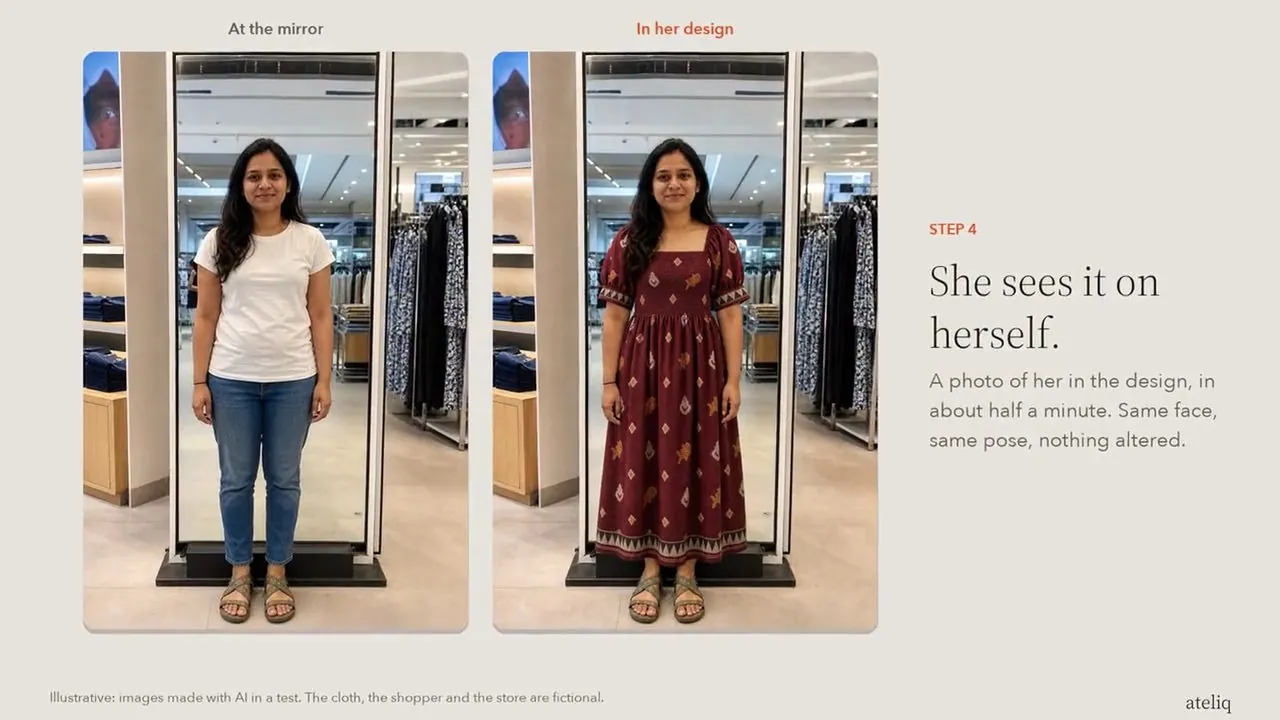
In Ateliq today. The shopper scans the cloth's tag at the mirror and answers two short questions: the occasion, and how long. She can send a picture of a dress from her phone through a QR code; it lends the shape only and is deleted when her visit ends. Ateliq shows three dresses made from that exact cloth, then a photo of her in one, works out the cloth, stitching and days, and sends the design to the store's tailor with her sizes.
8. Fabric sourcing and product passports
The job today. Sourcing teams email mills for swatches, prices and minimums, and gather certificates and origin records in folders. For brands selling into Europe, that record is about to matter more. Textile apparel is a priority product group under the EU's Ecodesign for Sustainable Products Regulation, in force since July 2024, and its digital product passport rules are planned for adoption in late 2027.
- What the agent does: matches the fabric a design needs (fibre, weight, width, finish, quantity) to approved suppliers, drafts enquiries, and assembles the fibre, origin and certificate records for each style as the season goes.
- Who approves: the sourcing lead approves every enquiry and every order; compliance signs off the records.
- Data it needs: an approved supplier list with minimums and lead times, past orders, and the certificates suppliers have shared.
- How to measure it: days from approved design to confirmed fabric, the share of styles with a complete record, and missed deadlines.
- Risks and guardrails: an agent can only pass on what suppliers declare. Never let it fill a gap in a record with a guess, and keep orders and payments with people.
Where the market is heading. Ateliq does not do fabric sourcing. We expect sourcing agents to become the way brands keep passport-ready records, because the work is mostly gathering and checking documents.
9. Range reviews
The job today. Before a range is locked, merchandisers and designers walk the line: is there a piece for every price band, occasion and size? Are there three near-identical black dresses? Is anything missing for the wedding season or Eid? The review runs on spreadsheets and memory.
- What the agent does: checks the planned range against last season's sales, the approved trend board and recorded gaps, and drafts a short note: where the range is thin, where it overlaps, and which planned pieces look like last season's slow sellers.
- Who approves: merchandising and design own every decision; the agent only writes the note.
- Data it needs: the planned range with attributes and prices, sales and returns history, the festive and wedding calendar for each market, and unmet-demand records.
- How to measure it: full-price sell-through and markdown depth against the previous season, and gaps found before the range was locked rather than after.
- Risks and guardrails: sales history hides what was never stocked. Read it next to unmet demand, and next to try-on data where you have it.
Where Ateliq is today. Ateliq supplies inputs a range review needs: weekly store reports of what was tried, asked for, bought, kept and returned, and the unmet-demand list. Head office can also ask its stores a question in plain words and see exactly what the answer was read from. It does not plan ranges. Where the market is heading: range agents that read planning tools, sales and store signals together.
10. Originality and rights checks
The job today. A designer's eye and, now and then, a lawyer's letter. As more concepts start with AI, brands need a record of what went in, who changed what, and whether a design is too close to an existing one.
- What the agent does: compares each new concept with the brand's archive and flags close matches; records the sources used (the brand's own photos, a licensed print, a craft partner's motif) and every human edit; and adds a label when an image was made with AI.
- Who approves: the design director, with legal advice for anything flagged.
- Data it needs: the archive, licences and model releases, and a log of edits.
- How to measure it: share of designs with a complete record, flags raised before sampling, and disputes.
- Risks and guardrails: in the US, the Copyright Office has said that prompts alone are not enough for authorship, while human selection, arrangement and changes can be protected. In the EU, Article 50 of the AI Act has applied since 2 August 2026: AI-generated images must be marked in a machine-readable way, and deepfakes disclosed. Keep the designer's contribution substantial and recorded, and take advice from IP counsel. This is not legal advice.
Where Ateliq is today. Every image uploaded to Ateliq carries a rights statement: the brand owns the photo, or holds a model release. A shopper's photo from the screen never becomes a brand asset. It does not run similarity searches against outside designs. Where the market is heading: provenance records built into design tools, so the record is made as the work is done.
How to start in 90 days
Pick two use cases, not ten. For most design teams the best pair is one that feeds the studio (use case 1 or 2) and one that saves sampling (use case 3 or 6).
- Days 1 to 30: get the inputs right. Clean the tags on your catalogue, write down your brand codes on one page, agree who approves what, and start recording unmet requests in one format. Choose two or three measures, such as days from brief to first review and sampling rounds per style, and take a baseline.
- Days 31 to 60: run the agent beside the team. Let it draft the weekly board, the briefs or the concepts while the team works as usual. Review every draft, note what was used, changed or thrown away, and tune the instructions.
- Days 61 to 90: let it carry part of the load. Move the drafts into the real weekly rhythm, test the best concepts with shoppers, and compare the measures with the baseline. Then decide: keep, change or stop.
For how to set up a fair comparison, see our guide to measuring an in-store AI pilot, and for turning signals into briefs, from demand signals to new designs.
Take the playbook, or see it live
We have collected all 40 use cases from this series, for fashion design, fashion retail, jewellery retail and jewellery design, into one free guide with a readiness checklist, a 90-day pilot plan and a vendor scorecard: The Agentic AI Playbook for Fashion and Jewellery. To see an agent design from a cloth and a shopper try it on, open the live demo.
The image at the top of this article was made with AI in a test. The cloth, the shopper and the store are fictional.
Sources
- US Copyright Office, Copyright and Artificial Intelligence, Part 2: Copyrightability
- EU AI Act, Article 50: transparency obligations
- European Commission, digital product passport for textile apparel and implementing the ESPR
- IP India, registration details of Geographical Indications
- PIB, National Handloom Day 2026 backgrounder
- European Commission, transparency obligations under Article 50 of the AI Act
Questions people ask
What is agentic AI in fashion design?
Agentic AI means AI agents that read, decide and act within limits a person sets. In fashion design, an agent can read trend sources and store data, draft a weekly brief, draw concepts from a print or sample and test them with shoppers, while a designer approves everything that goes forward.
What are the best agentic AI use cases for fashion design?
Trend scouting into a weekly brief, briefs from unmet demand, concepts in the brand's own style, print and colourway development, tech packs, testing concepts with shoppers before sampling, designs from a shopper's chosen cloth, fabric sourcing and product passports, range reviews, and originality and rights checks.
Can AI design clothes from a fabric a shopper chooses?
Yes. In Ateliq, a shopper in a handloom or fabric store scans the cloth's tag at the mirror and sees three dresses made from that exact cloth, keeping its weave, motifs, colours and border. She can see one on herself, and Ateliq sends the design to the store's tailor with the cloth, stitching and days worked out.
Who owns a fashion design made with AI?
In the US, the Copyright Office has said prompts alone are not enough for authorship, while human selection, arrangement and changes can be protected. Keep the designer's contribution substantial and recorded, and take advice from IP counsel.
Do AI design agents replace designers?
No. Agents take the gathering and first drafts: trend reading, briefs, concept variations and records. Designers keep taste, judgement and sign-off, and nothing reaches a factory, a shopper or the public without their approval.
How should a design team start with AI agents?
Pick two use cases, such as weekly trend briefs and testing concepts before sampling. Spend 30 days preparing tags, brand codes and baselines, 30 days running the agent beside the team, and 30 days letting it carry part of the work before deciding to keep, change or stop.